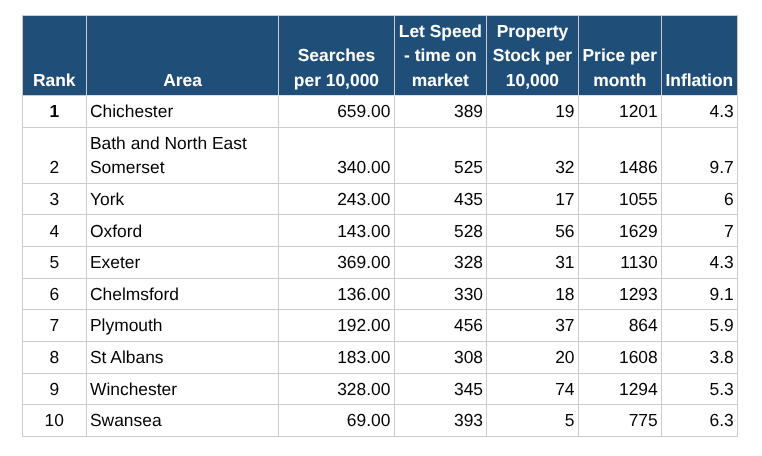
 Chichester has emerged as the UK’s most competitive rental market, according to new research highlighting rising demand across key regional hotspots.
Analysis by Pepper Money, which assessed 42 locations using metrics including search activity, rental inflation, stock levels and letting speeds, found the West Sussex city ranked highest overall.
Chichester recorded 659 searches per 10,000 people – the highest in the study and nearly double that of Exeter, the next highest ranking location for search activity. Average rents in the city are just over £1,200 per month, with strong demand particularly for three-bedroom homes.
Bath and North East Somerset ranked second in the index, driven by high search interest and some of the fastest rental price growth in the country. Rents for one- and two-bedroom properties in the area have risen by an average of 9.7% annually, with typical monthly costs around £1,550.
York placed third, supported by steady demand and rental growth of around 6%, slightly above the national average.
Other high-ranking locations included Oxford, Exeter, Chelmsford and Winchester, with the list dominated by southern and commuter-belt markets where supply remains constrained.
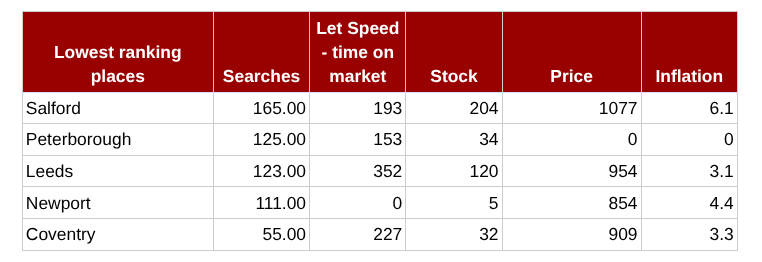
At the other end of the index, Salford ranked lowest due to a high volume of available rental stock, with 204 properties per 10,000 people – more than four times the study average. Peterborough and Leeds also featured among the weakest markets, reflecting lower search demand and longer letting times.
Paul Adams, sales director at Pepper Money, said: “We can see that rent is continuing to grow in demand in the UK. Our research highlights strong levels of search interest across 42 locations, alongside very short letting periods.
“Properties such as semi-detached homes and 3-bedroom homes are on the market for just 122 days and 132 days, respectively. This suggests that renters are moving fast to secure their homes in an extremely competitive market, and it’s something that landlords can see and work with renters to secure desired tenants.”
Adams added: “As this shift in renting continues, there is an opportunity for renters and landlords to work more closely together. There is a greater demand for stability, reliability and more trust on each side.
“Landlords who understand the evolving needs of their renters, such as longer tenancies and, in some cases, more space, are at a greater chance of succeeding and securing those longed-for tenants in this competitive market.”