

Many buy-to-let landlords remain unclear about the implications of the Renters’ Rights Act as they grapple with a wave of legislative changes affecting the private rented sector.
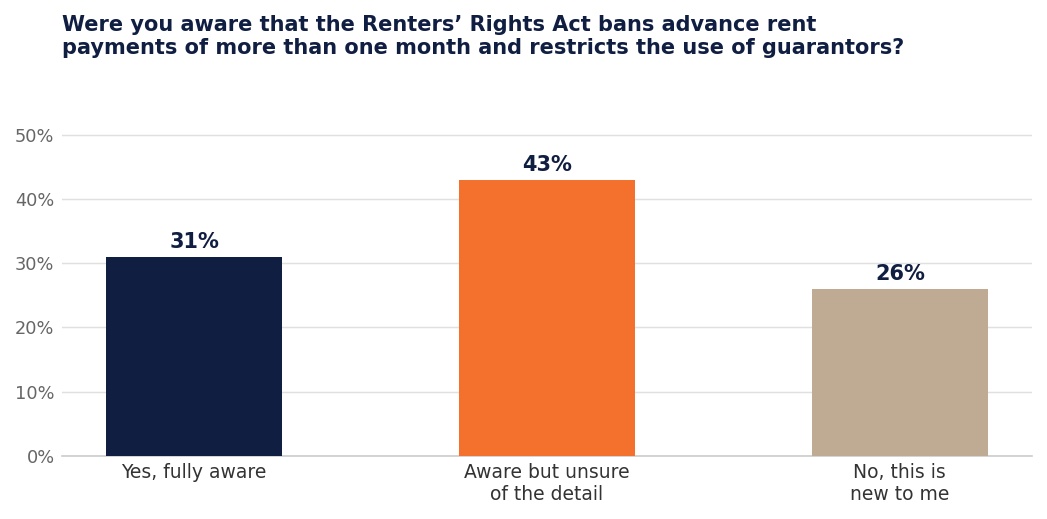
New research from LRG found that fewer than a third of landlords are fully aware that the legislation bans advance rent payments of more than one month. The survey of 650 landlords and tenants across England and Wales revealed that 43% know the rules have changed but are unsure of the details, while a further 26% were unaware of the restriction altogether.
The findings are drawn from LRG’s Spring 2026 Lettings Report, which analyses responses from landlords and tenants to assess how the private rented sector is responding to what is widely regarded as the most significant legislative overhaul in a generation. The Renters’ Rights Act abolishes fixed-term tenancies, introduces Assured Periodic Tenancies, and restricts advance rent payments to no more than one month. Together, these measures mark a fundamental shift in how the private rental market operates, yet many landlords are still working through what the changes mean in practice.
While the intention behind the reforms is not in question, the data suggests a growing concern that some tenant-protection measures may be producing unintended consequences. With advance rent payments now limited, 58% of landlords expect to see an increase in borderline or higher-risk applications, including 18% who anticipate a significant rise. By contrast, just 10% believe the quality of applicants will improve, suggesting the policy may be encouraging greater caution among landlords rather than broadening access to housing.
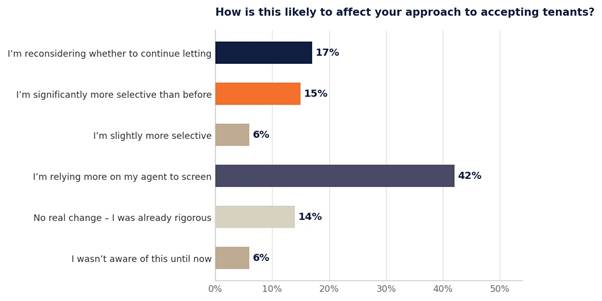
This shift is already reflected in landlord behaviour. Around 38% say they are either reconsidering their position as landlords or are becoming significantly more selective about tenants, indicating a tightening of supply at a time when demand remains high. A further 6% report becoming slightly more selective. The most common response, cited by 42% of landlords, is an increased reliance on letting agents to screen applicants, highlighting the growing importance of professional intermediaries in maintaining market confidence and operational stability.
The risk of further supply contraction is supported by wider data. The English Private Landlord Survey shows a steady increase in the proportion of landlords planning to reduce the size of their portfolios in recent years. LRG’s findings add further context: 70% of landlords say they would not consider letting to a local council or housing association, and fewer than 1% currently do so. For tenants unable to secure housing in the open market, this limits access to one of the remaining alternative routes into accommodation.
The impact of Renters’ Rights Act changes for landlords is also reflected in tenant dependence on the sector. LRG’s survey indicates that 69% of tenants describe themselves as heavily or entirely reliant on private renting, with no realistic alternative. This sits alongside ongoing affordability pressure. ONS data shows that private rents have increased faster than average earnings across most English regions over the past three years, reducing tenants’ capacity to absorb further tightening in supply or increased selectivity from landlords.
The private rented sector accounts for around 4.6 million households in England, according to the English Housing Survey. Any reduction in supply—whether driven by landlord exits, more selective letting practices, or both—would increase pressure on a market already accommodating a large share of housing demand. With the Renters’ Rights Act now in force, implementation and clarity of guidance will be key factors in determining how far the reforms affect overall supply and access.
Allison Thompson, chief lettings officer, Leaders part of LRG, commented, “The Renters’ Rights Act has some genuinely important protections for tenants, and we support the direction of travel. But the data should give policymakers pause. When more than half of landlords expect to see higher-risk applications as a direct result of removing advance rent, and 17% are considering leaving the sector altogether, we have to ask whether the rules are working as intended.
“The tenants who most need stability are the same ones who will struggle most if supply contracts further. Agents have a critical role to play right now – helping landlords navigate the changes, stay in the market, and keep letting to a wide range of tenants.”







Comments (1)
I can see no reason to ban rental payments of more than one month in advance. We accepted 6 months in advance from a young man who was moving to the area to start a business. In theory he was unemployed, had no landlord references but we liked him and without his offer of upfront payment would never have offered him a home. He was with us for almost 10 years and an excellent tenant. Parents who want to see their children settled in their own home, for a variety of reasons also offer 6 months in advance as well as a guarantor. Their offspring pays the rent to the parents, pays off their debt, everyone is happy. As long as the offer comes from the tenant it should remain.