
An analyst says that Purplebricks has hit a glass ceiling in terms of market share – it is profitable but its revenue growth in the UK has effectively stopped.
Mike DelPrete, analysing Purplebricks’ results for the first half of its 2019/2020 financial year (the six months to the end of October), says that these reveal a business “whose growth has clearly plateaued and reached maturity in the UK”.
He goes on: “The company appears to have reached peak efficiency, putting a ceiling on its future growth prospects.”
However, DelPrete does say that Purplebricks’ profitability in the UK is a “rarity in the world of real estate tech brokerages”, pointing out that similar businesses overseas, such as Redfin, Compass and Opendoor, are all unprofitable.
DelPrete also says that the fundamentals of the Purplebricks business model are sound.
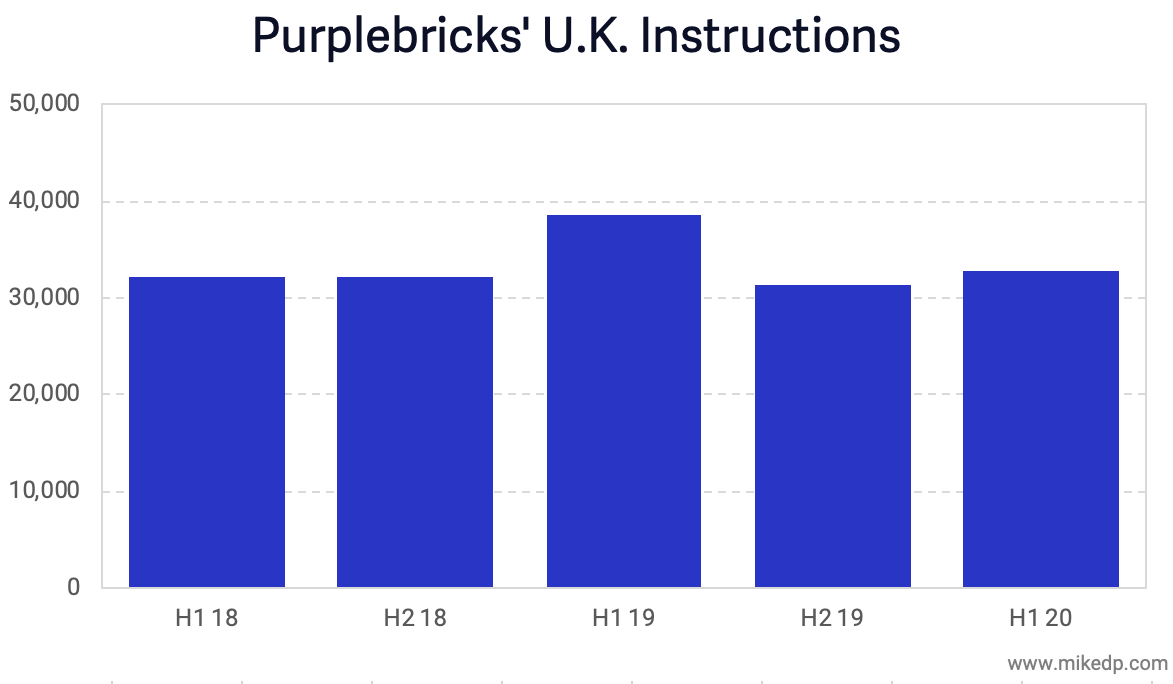
However, customer numbers as measured by ‘instructions to sell’ have remained flat over the last two and a half years.
DelPrete also says that the cost of customer acquisition has changed little in three years, at £375 per customer.
DelPrete concludes: “I continue to use Purplebricks as a case study of successful disruption in my university course on real estate tech. Going from an idea to the largest estate agent by market share in the UK, with a profitable business model (in the UK, at least), is impressive and worthy of study.
“In the UK, Purplebricks succeeded where every other hybrid agency failed: by scaling.
“While its competitors slowly went out of business while failing to demonstrate a path to profitability, Purplebricks – partially through sheer force of will and spending power – managed to scale to the point of profitability.
“But while Purplebricks managed to cross that first chasm, it never really made it over the next one: becoming a platform. The business still scales linearly based on marketing spend and people; I’ve yet to see evidence to support a credible path to double-digit market share.
“In the UK this may be as big as the business can get – a high-water mark for the hybrid agency model.”
Below, customer instructions for the first half of its 2019/2020 financial year, the six months to the end of October






Comments (13)
The business is not sustainable – you can’t have that many customers running around and slating the business.
Being paid £1000+ and not selling the home nets you a reputation that will see this company sink.
This is no more than a parent will do when a child’s beloved pet is terminally ill.
You can’t tell them their dog is dying – you start by explaining Rover has a runny nose.
Next – its’ fur is staring to fall out in patches.
Then – the poor bu99er goes blind, deaf or incontinent. Eventually all three. Time to explain all about how Rover will soon be chasing other doggies around on a cloud.
DelPrete clearly thinks that he can use these tactics to telegraph the collapse of his pet whilst still referring to it in a reasonably loving manner…
…although he simply wishes it would pass away quickly before the real sh!t starts to squirt uncontrollably from every orifice.
Had a look at Purplebricks Homes page.
No 1 at selling hosues for the last two years.
if you then happen to scroll down right to the bottom of the page (which as jow public you wouldnt) in miniscule writing which is hard to even read
Fee payable on instruction or up to 10 months after advert is published if deferred. Viewings services can be arranged for £300 and £399 in London and surrounding areas. All sales claims based on independent data from Twenty Ci for the periods May 17- April 18 and May 18- April 19.
This is whats wrong wrong with this comapny.Complete fabication back up by very weak sources and hidden away.
Kings Of Spin may have left but some of the tricks remain and no one seems to be able to do anything aout it.
At least Carlsberg had to decency to add “proabably” !!
Definitive ‘smoke & mirrors’.
The test for PB will be the public reaction if they ever find out how good or not they really are at getting the property to completion. As PB continues to refuse to disclose this irrefutable information one can only come to one conclusion, they are hiding the truth which their customers will not be pleased to hear and be a catastrophic disaster for the industry to try and pick up the pieces.
“…and be a catastrophic disaster for the industry to try and pick up the pieces.”
The damage to our industry is the fundamental issue here. At the point of going bust, emoov had over 2000 customers who had paid them money and did not receive a “service” for that payment. Add to that the 0000s of customers that they had taken money from and not delivered a result for over the years. Lump on top of those the figures for Tepilo before it became part of that particular house of cards.
Same with HouseNetwork. Hatched. Estates Direct – the list of shame on our industry goes on.
But all lumped together, the failings of the above shameful list don’t come anywhere near the current numbers of the PurpleEmperor.
Now that people can see the Emperor’s winky (credit: Robert May), even devout fanboys like DelPrete realise the need to start admitting the stark reality.
For them, saving whatever face they can in the light of overbearing evidence is the fundamental issue. These people have no thought for the customer – only the next opportunity to ride a wave as far and fast as it will take them.
At some point the ‘self employed’ status of LPEs will be revealed for what it is. At that point PB is Kaput. This assumes they don’t run out of cash first. As for Mike DelPrete, he’s been their number one cheerleader for years so not a viewpoint to be taken seriously.
With first time buyers no longer desiring poor quality terraced stock in poor industrial towns in the north and there being no landlords to speak of, let PB have them.
They won’t be able to sell them and this will ultimately add to their poor reputation.
Of course it has stopped. They’ve managed to bully the top agents out of the business and now left with a bunch idiots at the top table who have never done the job before. Total shambles. There was a time it was one to watch, now it’s just a waiting game for the rest of the talent to leave.
It’s only profitable while people continue to work for 1/2 of minimum wage or less. Once the Lemmings stop joining and they have to pay people properly…. the profit will no longer exist.
A company built solely on the work of slaves…
Kenny and Michael will eventually be made accountable, surely?
The linear growth proportional to market share is inevitable when there is no recurring revenue stream. This was obvious from the start. How some people become analysts and fund managers with such limited insight is something I don’t understand.
…….and like the Loch Ness Monster, we’ll never see actual Sold/Exchanged data versus Properties Instructed For Sale by Purplebricks.
Purplebricks business model is perched upon that single statistic, it wobbles away, shrouded in secrecy.
It’s one thing listing properties for sale, however for the trapped Purplebricks client, being sold/exchanged versus just being listed for sale is merely a dream.
The love affair finally over .
!But while Purplebricks managed to cross that first chasm, it never really made it over the next one: becoming a platform.
A damning report if ever there was. They must have stopped paying him! Next up Hardmans?