 UK annual house price growth picked up to 2.2% in June, from 1.7% in May, according to Nationwide’s June (and Q2 regional) House Price Index.
Northern Ireland remained best performing region, with prices up 8.6% year on year in Q2 2026.
Outer South East weakest performing region, with 0.1% annual rise
| Headlines | Jun-26 | May-26 |
|---|---|---|
| Monthly Index* | 550.7 | 550.9 |
| Monthly Change* | -0.0% | -0.6% |
| Annual Change | 2.2% | 1.7% |
| Average Price
(not seasonally adjusted) |
£277,484 | £278,024 |
* Seasonally adjusted figure (note that monthly % changes are revised when seasonal adjustment factors are re-estimated)
Robert Gardner, Nationwide’s chief economist, said: “Annual house price growth picked up to 2.2% in June, from 1.7% in May, although prices were broadly flat in month-on-month terms, after taking account of seasonal effects.
“It is not surprising that the market has softened a little in recent months, given the uncertainty caused by developments in the Middle East and the subsequent rise in energy prices and market interest rates. Indeed, consumer confidence and measures of housing sentiment have weakened, and mortgage approvals fell noticeably in May.
“While geopolitical tensions remain high, the signing of a memorandum of understanding between Iran and the US helped push oil prices back towards the levels prevailing before the conflict began.
“If the energy shock continues to subside, the Bank of England may not need to raise interest rates, or at least by less than had previously been anticipated – a view reinforced by the fact that UK inflation has also been lower than expected in recent months.
“In recent weeks a shift in market expectations for the future path of Bank Rate has helped to bring down the market interest rates which underpin fixed-rate mortgage pricing.
“If maintained, these trends will help to restore household confidence and ease affordability constraints, paving the way for a recovery in housing market activity in the coming quarters, providing that domestic political uncertainty does not adversely impact sentiment.
All regions see annual price gains in Q2
Nationwide’s regional house price indices are produced quarterly. The data for Q2 (the three months to June) indicates that all thirteen regions saw positive annual house price growth, with all but one recording growth in the 0% to 4% range.
Regions over the last 12 months
| Region | Average price
(Q2 2026) |
Annual % chg this quarter | Annual % chg last quarter |
|---|---|---|---|
| N Ireland | £226,699 | 8.6% | 9.5% |
| North West | £231,415 | 3.9% | 3.3% |
| North | £173,756 | 3.9% | 2.6% |
| Scotland | £195,928 | 3.5% | 3.0% |
| Wales | £220,337 | 3.5% | 2.7% |
| West Midlands | £256,592 | 3.2% | 0.0% |
| Yorks & The H | £217,518 | 2.9% | 1.6% |
| East Midlands | £240,482 | 1.8% | 0.3% |
| London | £540,903 | 1.6% | 1.7% |
| South West | £310,429 | 0.7% | 0.1% |
| East Anglia | £274,375 | 0.3% | -0.4% |
| Outer Met | £432,173 | 0.3% | 1.0% |
| Outer S East | £341,175 | 0.1% | -0.7% |
| UK | £278,784 | 2.2% | 1.5% |
Northern Ireland was again the exception, with price growth continuing to outpace the rest of the UK by a wide margin. Indeed, at 8.6% the rate of annual price growth was around four times faster than the 2.2% recorded in the UK as a whole (in Q2), where the strong performance echoes the trend seen in the border regions of Ireland.
This persistently strong performance has resulted in a deterioration in housing affordability in the region, in contrast with the UK average, which has generally been improving.
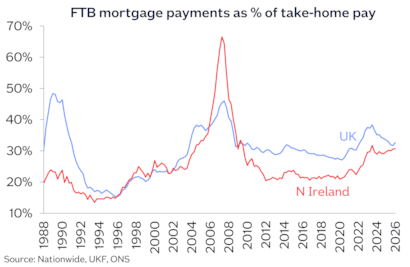
Indeed, the mortgage payment on a typical first-time buyer property in Northern Ireland is now equivalent to 31% of an average earner’s take home pay, up from 24% in Q2 2022 – although this is still lower than the UK average of 33% (see chart below). Moreover, the price of a typical home in Northern Ireland is now around 80% of the average UK price, up from 70% in Q1 2024, but still well below the peak of 125% recorded in 2007.
Scotland and Wales both saw a slight pickup in annual house price growth in Q2 to 3.5%, while England also saw an acceleration, albeit to a modest 1.5%, from 0.9% in Q1.
Average prices in Northern England (comprising North, North West, Yorkshire & The Humber, East Midlands and West Midlands) were up 3.1% year on year, with the North West (which includes areas such as Cheshire, Lancashire & Greater Manchester) remaining the top performing region in England – with prices up 3.9% year on year.
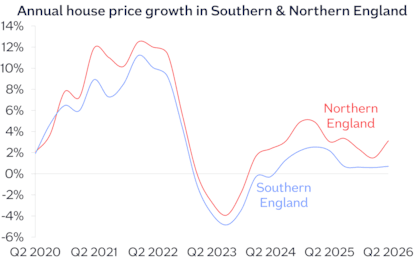
Average house price growth in Southern England (South West, Outer South East, Outer Metropolitan, London and East Anglia) was broadly stable at 0.7%. London remained the strongest southern region, albeit with a modest annual price rise of 1.6%. Meanwhile, the surrounding Outer Metropolitan and Outer South East regions recorded even more modest rises of 0.3% and 0.1% respectively.
Nations summary table
| Nations | Average price
(Q2 2026) |
Annual % chg this quarter | Quarterly % chg |
|---|---|---|---|
| N Ireland | £226,699 | 8.6% | -0.2% |
| Scotland | £195,928 | 3.5% | 1.1% |
| Wales | £220,337 | 3.5% | 0.9% |
| England | £315,208 | 1.5% | 0.3% |
| UK Fact File (Q2 2026) | |
|---|---|
| Quarterly average UK house price | £278,784 |
| Annual percentage change | 2.2% |
| Quarterly change (seasonally adj.) | 0.6% |
| Most expensive region | London |
| Least expensive region | North |
| Strongest annual price change | N Ireland |
| Weakest annual price change | Outer S East |
Energy efficiency ratings have limited impact on owner-occupied house prices, despite increased interest in ‘going green’
Gardener explained: “Using data for homes in England, we examined the extent to which those buying properties pay a premium (or discount) due to the EPC rating. Our research also included other property characteristics (such as bedrooms, location and whether it is newly built) to estimate the impact on prices1.
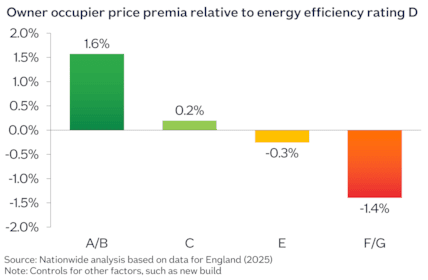
“Our analysis suggests that a more energy-efficient property rated A or B attracts a modest premium of 1.6% compared to a similar property rated D. This is equivalent to around £4,500 based on the average house price in England. There is little difference for properties rated C or E, compared with D, as shown in the chart below. We do see a small discount for the least energy efficient properties however, with an F or G-rated home valued 1.4% lower than a similar D-rated property. This equates to around £4,000 in cash terms.”
He continued: “It is interesting to note however, that energy efficiency continues to have a much greater impact on buy-to-let purchases, where an A or B-rated property attracts a 12.2% premium. For further details see our
What green improvements are homeowners making?
Nationwide’s recent market research suggests around three quarters (78%) of homeowners expect buyers to pay more for an energy efficient home2. This was particularly evident amongst younger buyers, where nearly a third (32%) of those aged 25 to 34 expected buyers to pay significantly more for an energy efficient home, compared to just 5% of those aged 55+. Additionally, 69% of respondents believed that EPC ratings/energy efficiency matters more now than when they bought their home.
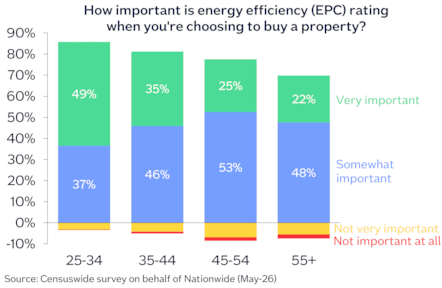
Over half (54%) of those surveyed were not aware of their current property’s energy efficiency rating. Despite this, 77% said that EPC rating would be an important factor when choosing a property to buy in the future. Again, this appears particularly significant for younger buyers (i.e. those aged 25-34), where nearly half (49%) stated this would be ‘very important’.
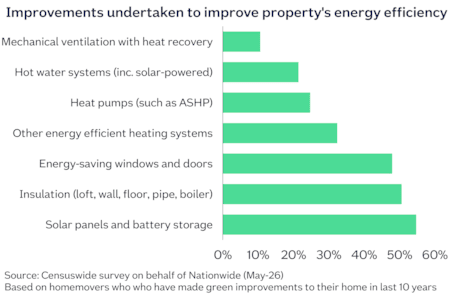
Of homeowners who had undertaken measures to improve their property’s energy efficiency in the last ten years, the most popular were: adding solar panels, improving insulation and upgrading to energy-saving windows and doors.
The main reasons cited for making green improvements were to reduce energy bills (60%) and to make their home more comfortable (48%). Nearly three quarters (73%) said they had seen energy bills fall as a result of the improvements they made. This is consistent with data from the Department for Energy Security and Net Zero, which suggest median equivalised fuel costs for a property rated A, B or C are around £400 per year lower versus a D-rated property and £1,200 per year lower than an E-rated property.
Industry reaction:
Nathan Emerson, CEO at Propertymark: “House price growth demonstrates that there remains a healthy level of demand across many parts of the UK, despite ongoing affordability pressures. However, national house price trends only tell part of the story, with Propertymark member agents continuing to report significant regional variations depending on local supply and buyer demand.
“Sellers should be encouraged by rising values, but realistic pricing remains crucial. Homes that are marketed at the right price continue to generate the strongest interest, whereas overpricing can quickly reduce momentum. A balanced market, supported by greater housing supply, remains the best outcome for both buyers and sellers.”
Marc von Grundherr, director of Benham and Reeves: “Flat house prices aren’t enough to suggest the market is losing momentum. Housing has never moved in a straight line and short-term fluctuations are part and parcel of a healthy market. It’s the long-term trends that tell stories, and in this case annual house price growth has edged higher.
“The buyers we’re seeing aren’t being put off by marginal price movements. They’re focused on finding the right home, and with mortgage affordability continuing to improve, the appetite to move remains firmly intact.
“If anything, a modest correction can help keep the market moving by giving buyers greater confidence to commit, rather than signalling the start of a broader downturn.”
Verona Frankish, CEO of Yopa: “Prices remaining essentially unmoved on the month is definitely not a sign that buyer demand has dropped off. The market remains active and realistically priced homes are continuing to attract plenty of interest. A little more breathing space on pricing could even encourage more buyers to take the plunge, helping to keep transactions moving over the months ahead. And the annual increase also shows that over the long-term, the market is still in a good position.”
Tom Bill, head of UK residential research at Knight Frank: “Sideways house prices and falling transaction numbers underline the absence of a seasonal spring bounce. However, as greater stability returns to energy markets, we have seen mortgage rates edge lower, which will support demand. Just as one headwind eases, another gathers strength. Rising domestic political uncertainty means we may see another summer of speculation around tax, which would keep a lid firmly on activity.”
Chris Hodgkinson, managing director of House Buyer Bureau: “Sellers don’t need to panic, but flat values do make realistic pricing and certainty more important than ever. In any market, buyers remain active for homes that represent good value, while overpriced properties are often the ones left sitting unsold.
“For sellers who need to move quickly, speed and security can be worth far more than holding out in the hope of squeezing out a marginally higher offer. In today’s market, a guaranteed sale is often the biggest advantage of all.”
Iain McKenzie, CEO of The Guild of Property Professionals: “The latest Nationwide HPI data highlights the resilience of the UK housing market, with annual house price growth picking up to 2.2% in June from 1.7% in May, despite prices remaining broadly flat on a month-on-month basis once seasonal factors are taken into account.
“While the market continues to navigate a mix of economic and political uncertainty, there are signs that conditions are gradually improving. Inflation remains above the Bank of England’s 2% target, but the decision to hold Bank Rate steady has provided mortgage lenders with greater confidence to reduce rates and compete for borrowers. We are already seeing a number of lenders cutting mortgage deals, which will help improve affordability, increase borrowing power and give some buyers renewed confidence.
“Although transaction levels dipped by 2% month-on-month in May, the market remains active and resilient. The 98,450 transactions recorded were still 17% higher than the same period last year, demonstrating that demand has not disappeared, it is simply becoming more considered. Many buyers and sellers are taking a measured approach while they assess wider economic conditions, but those with a genuine need to move continue to progress with their plans.
“One of the biggest influences on today’s market is the increased choice available to buyers. In the current market, purchasers have more options and greater negotiating power. This makes accurate, evidence-led pricing more important than ever for sellers looking to attract serious buyers and achieve successful outcomes.
“Overall, the market remains one of adjustment rather than decline. As mortgage rates continue to evolve and affordability pressures ease, we expect activity to gradually strengthen, supported by the underlying demand from people who need to move.”
Jason Tebb, president of OnTheMarket: “Average property values were flat on a monthly basis as focused, price-sensitive buyers negotiate, while sellers realise that they will struggle to sell over-ambitiously priced homes when there is so much stock to choose from in some areas.
“Despite the impact of the Middle East conflict on inflation and subsequently interest rates, stalling the expected downwards momentum of base rate this year, the resilience of the housing market is evident. The Bank of England’s decision to hold interest rates at the past four meetings is having a steadying effect, suggesting a calm, considered approach with no need to panic.
“As lenders trim their mortgage rates, buyers worried about affordability will find the situation is easing slightly.”
Ian Futcher, financial planner at Quilter: “UK house price growth flatlined in June with a 0% monthly change, while annual house price growth edged up to 2.2%, according to the latest Nationwide house price index. This has brought the average house price to £277,484.
“The data also show that the outer South East saw the weakest growth in the second quarter, with house prices rising by just 0.1%, while Norther Ireland saw another 8.6% jump. London retained its position as the strongest southern region with relatively steady growth, dipping only slightly to 1.6% from 1.7% in the prior quarter.
“Market momentum has been significantly dampened in recent months as the situation in the Middle East continued to evolve. The pressure it has placed on energy prices and inflation, combined with the resulting uncertainty around the path of interest rates and broader affordability challenges, has made prospective buyers much more cautious.
“While a ceasefire has since emerged, the effects of the conflict won’t disappear overnight. Recent data already points to a cooling market, with property transactions edging lower in May and Bank of England figures showing weaker mortgage borrowing and fewer approvals for house purchases.
“Against this backdrop, many prospective buyers are continuing to delay making any major financial commitments. Confidence remains fragile and, after a lengthy period of fluctuating mortgage rates, households are understandably reluctant to make a move until there is greater certainty over borrowing costs and the wider economic outlook.
“While significant falls in mortgage rates are unlikely to materialise for some time yet, competition between lenders could create some opportunities. For buyers and homeowners approaching a remortgage, reviewing options and seeking advice early will help put you in a stronger position as the market continues to adjust.”
Jonathan Hopper, CEO of Garrington Property Finders: “The dust is settling but that doesn’t mean it’s back to business as usual. Nationwide’s data shows that at a national level, prices flatlined between May and June.
“The regional data reveals which areas have got back into their stride and which have not.
“Northern England, Scotland and Wales all saw their annual pace of growth improve during the last three months. The West Midlands saw the biggest turnaround in fortunes between the first and second quarters of the year, with annual price growth leaping from zero to 3.2%.
“The North-South divide continues to grow and could be turbocharged by a Prime Minister Burnham. A huge injection of government spending into the north could create a Burnham bounce that accelerates northern price growth further.
“Meanwhile Nationwide’s data offers some modest good news for central London, where the prolonged slide in average prices is over. Nevertheless the capital’s malaise has now spread to outer boroughs and the Southeast commuter belt, where a glut of supply is holding down prices and allowing buyers to be choosy.
“As a result, even in highly desirable areas buyers are often able to demand – and get – significant price reductions; while those who are not convinced that a home is 100% right for them won’t hesitate to walk away.
“This is due to three factors – elevated interest rates, buyer caution and buyers’ sense that they have time and choice on their side.
“While mortgage interest rates have eased in recent weeks, and there are encouraging signs that they may tick down further in coming months, the extra cost of borrowing is still a barrier for mortgage-dependent buyers.
“The abundance of choice and lower purchase prices is finally tempting cautious buyers back to the market, but the road back to normality will be long and the prospect of major property tax changes under Britain’s latest prime minister is a dark cloud for a market still craving clarity and confidence.”