
Landlords are calling for a six month extension to the validity of all gas and electrical safety certificates to cover for the impact of the coronavirus.
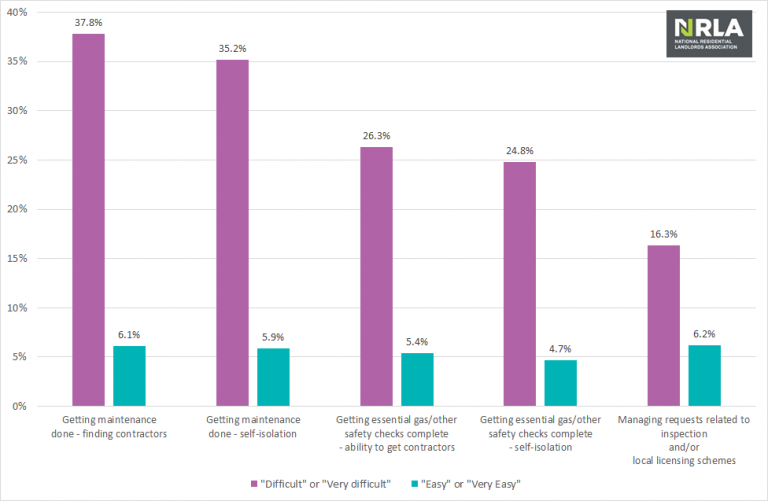
This comes in response to a RLA (Residential Landlords Association) survey in March showing that 38 per cent of landlords are struggling to source maintenance contractors to undertake required work and just over a third are having difficulties undertaking work in their properties because of either themselves, or their tenants, self-isolating.
Some of the responses shown in the survey, which has been published by the National Residential Landlords Association (into which the RLA merged in early April), highlight the issues:
“I am terrified I won’t be able to be ready for the new local selective licensing. I have two tenants who are vulnerable and must not have contact with anyone. I cannot get certificates.”
“Gas safety certificate is due on one property, but the tenant is vulnerable to the virus and therefore will not let anyone into property. We have to respect his health and well-being.”
“[The] electrician wants me present. I would not go into tenant accommodation to do check whilst they are there as it is impossible to keep 2m distance.”
“My regular handyman wants to wait until the risk goes before carrying out a small maintenance job at tenant’s property.”
With tenants concerned about letting people into their rental properties, the National Residential Landlords Association (NRLA) is calling for gas and electrical safety certificates expiring over the six month period from 1st April to be extended for six months. This would be in line with the Government’s approach to MOT certificates.
This would provide the time that landlords need to ensure routine, but legally binding checks, can take place at a point when the danger of spreading the virus in rental properties should be reduced.
The NRLA is also calling on the Government to delay until next year the introduction of new routine Electrical Installation Condition Reports which are due to come into force from 1st July.
These will involve inspectors checking the wiring in all rooms of a property, possibly taking a number of hours and making it nearly impossible for tenants to properly isolate.
The survey attempted to gauge the extent of these difficulties across the PRS.
Landlords were asked how easy or difficult it was to maintain their properties.
Results are set out in in the graph below and are presented by comparing those who had found it “Difficult” or Very difficult” against those finding it “Easy” or “Very easy”.
Ben Beadle, Chief Executive of the NRLA, said:
“Whilst landlords should ensure that urgent work to ensure properties are safe for tenants is carried out, routine maintenance and checks need to be delayed to prevent the spread of coronavirus.
“Extending the life of gas and electrical safety certificates will protect landlords and tenants from unnecessary contact and provide landlords with legal protection from enforcement action where they are simply unable to get such work undertaken through no fault of their own.”
The survey, which focused on the views across the Private Rented Sector (PRS) on the government package of measures which support tenants and landlords, was undertaken by the RLA at the end of March, just before the RLA and NLA (National Landlords Association) merged. The intention is to run a second survey in a few weeks time of the entire NRLA membership .
The key findings were:
Landlords were concerned about the sustainability of their income streams. Many landlords rely on their rental income – in many cases to supplement inadequate pensions.
Landlords are facing problems getting routine maintenance and safety checks on their properties completed. This is reducing the quality of offer in the sector and making landlords nervous about falling foul of regulations.
In contrast to the perception of landlords, many are being sympathetic to tenant hardship and distress.
Landlord assessment of the overall package of support for the PRS was broadly neutral to positive.
There was however strong levels of support for individual elements of that package.
Full details of the survey can be found here.





Comments (9)
Gas safety certs and the new electrical certs need to be postponed/extended. End of.
We’re managing gas safety certs fine. The electrical checks are for new tenancies, so as long as there is a period when the property is empty its manageable.
I can only speak for our business, but our gas and electrical contractors are happy for the work. They only go into empty (tenant absent) houses, they have industrial face masks and it’s worked well so far. We’re only doing emergency maintenance and the landlords have given permission to just crack on with work. The tenants are asked to vacate the premises if necessary and are happy to do so – the good weather has helped.
We’ve already had a gas leak at a property and it’s very worrying for tenants – I’d be loathe to delay gas safetys, except where tenants flatly refuse to allow access – which we document in full.
The EPC is the worrying one. That’s not manageable on tenanted properties at the moment
But if a tenant is infected then the house is infected, surfaces and airbourne, and if C9 is in aerosol form (not yet determined) masks are ineffective. A tenant should know if there is a gas leak and that’s a different matter.
Re the new electrical testing requirements don’t forget that Statutory Periodics are treated as new tenancies
Not correct for the new electrical testing regulations. They are only required for a continuing tenancy by April 2021 at the latest.
An EPC isn’t required for an ongoing tenanted property only if it is being marketed to let
I was checking the alarm panel last week on an hmo and my tenant walked out of her bedsit and started coughing all over the hallway. She is a school teacher. I have no doubt it will be impossible to do my annual gas checks due next month, and I can hardly think of anything more dangerous right now than for a gas engineer to do the usual tour of my houses with all the tenants in place. How on earth can that be right?
It makes perfect sense to extend current certificates where there are no reported issues. At least until the end of July for any that have expired since lockdown, that will hopefully give gas engineers time to get back from furlough and catch up on them.
I wouldn’t agree with delaying the implementation of the electrical inspections until next year, a similar extension to the gas safety should suffice.
I am just entering into the electrical industry, I was due to have my AM2 at the start of May and was on my 2391 inspection and testing course when it got cancelled due to the lock down.
Depending on how long the lock down goes on for I am not sure the electrical industry will be ready, there was already a huge demand for the testing and inspection courses, I have managed to get on a course running in August and am hoping that goes ahead as there are no other dates now available due to everyone that was signed up to do the course having to be squeezed in later in the year.
As an example the estate agent I used approached me knowing I was going to be qualified shortly asking for help, they have 300 properties they managed and use one electrician who is pretty busy with maintenance work and other work, they were looking to start doing EICR’s as soon as possible.. Realistically an electrician should only really be doing one, maybe max 2 if they are small properties per day (Any electrician that says they can do more is making up the numbers). Then there are the remedial work which given a lot of properties will not have had an EICR, I am sure there will be a lot. I did EICR’s on two of my properties while they were empty a couple of months ago, both needed remedial work..
1. Bungalow – Complete rewire 5yrs ago.
– Failure code C2 – 10 Downlights needed replacing due to no earth continuity and single insulated 230v cables outside of an enclosure.
– Failure code C2 – Cables on over a fire exit not secured with metal support to reduce change of collapse during a fire.
– Failure code FI – Sticky tar coming from service head (Sorted by DNO)
2. 2 Bed house – New consumer unit and signed of by qualified electrician just over a year ago.
– Failure code C2 – Single insulated cables and choc box exposed not in a junction box to light fitting left above ceiling.
– Failure code C2 – Incorrect polarity on circuit to boiler.
– Failure code C2 – Cracked socket
– Failure code C2 – Socket not secured sufficiently to wall.
Maybe I am being more thorough than others but then you will not have a let to stand on in court if you get an electrician who populates the EICR with limitations as that will be on you.
At the moment there is no need to delay however a bit more leniency should be shown if the landlord is struggling to get an electrician to carry out the EICR or to do the remedial work.