
It is difficult to conceive of a more damning indictment to a Board of Directors than the letter sent yesterday to Countrywide, by Catalist, one of its major shareholders.
The letter, which Catalist made public, is long; the message is short –
“Fresh investor capital has evaporated and, with it, the trust of shareholders. Staff morale may justifiably be at an all-time low. The leadership of the company needs to be urgently addressed, not least to be able to attract the best talent. This cannot continue.”
Significantly, Catalist only bought into Countrywide in July, purchasing four tranches of shares during the month, and now holds just over 10% of its shares.
It is clear from the letter that they have been watching Countrywide carefully for an extended period of time. Buying in and then issuing this letter suggests the tactic is part of a pre-determined strategy which may well tip other major shareholders into action.
The letter become even more interesting when it is realised that Catalist is the trading name of Real Estate Investments 1 LLP.
That company was incorporated in May and its directors are Robin Paterson, Matthew Spence – the CEO of Natural Retreats, that briefly owned Humberts – banker Paul Coles, and former Nomura MD Joshua Ponniah.
Readers with long memories will recall that Robin Paterson has very strong credentials in estate agency investment.
In 1987 he purchased Barnard Marcus before selling it to Sequence, then headed the consortium that bought Hamptons International before selling it in 2004. He was a major shareholder in Cluttons and more recently bought both UK Sotheby’s International Realty and Coldwell Banker Commercial.
The industry has long since given up wondering why the shareholders have appeared to be content to watch Countrywide’s share value, and their investment, collapse over an extended period of time – and for the Countrywide Executive Chairman and Board to appear supine and utterly incapable to taking decisive action to halt the slide towards oblivion- which began with the appointment of Alison Platt and the decision to treat agency as ‘retail’.
It is therefore no great surprise that the Countrywide Board has apparently brushed off Catalist by refusing to engage with them or to make any commitment to do so in future.
Catalist ends its letter by saying: “As time is of the essence, should we be unable to reach consensus with you, we reserve our rights to pursue all options available to us as a significant shareholder.”
The markets appeared encouraged by the glimmer of a possibility of something positive happening at some point in the future. Countrywide shares closed yesterday at 145p, up 9.02% on the day.
19 August 2020
Peter Long
Executive Chairman, Board of Directors
Countrywide plc
Greenwood House, 1st Floor
91-99 New London Road
Chelmsford
Essex, CM2 0PP
Dear Peter,
I am writing to you on behalf of Catalist Partners (“Catalist”), a shareholder in Countrywide plc (“Countrywide”or the “Company”) which today controls 3,435,983 million shares, representing 10.48% of the common shares outstanding.
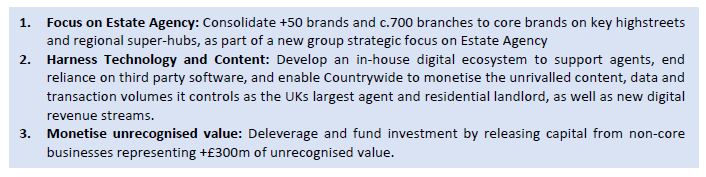
We first contacted you on 28 July 2020 to discuss a three-pillar strategy to unlock significant value in Countrywide plc (“Countrywide” or the “Company”) and position the Company for a successful future, namely:
We further presented this strategic plan at a virtual meeting on 4 August and then followed up on 6 August with a letter outlining the steps we think must be taken to right-size the Company’s balance sheet and put it on a stable path to capture future growth opportunities. We offered our assistance to help you implement this strategy and requested initial feedback from you and the Board by 14 August.
As we have made clear since we first communicated with you, our desire is to work constructively with you and the Board to achieve the outstanding potential that we all see in Countrywide.
We believe it paramount that Countrywide’s stakeholders – employees, shareholders, lenders and customers – receive immediate clarity on the Company’s plans to address the significant fall in the share price; adapt to current trading conditions; address emerging customer needs; respond to evolving competitor models and; critically, explain how this will be achieved, over what timeframe and who will implement such change.
The decline in Countrywide’s financial performance over the past four years has been disappointing. The Company’s competitors have outperformed on several key metrics and now command far higher valuations, despite generating lower revenues. While we agree with the disposal of non-core assets to release capital, disposals, pursued in our opinion without a transparent process, have failed.
Fresh investor capital has evaporated and, with it, the trust of shareholders. Staff morale may justifiably be at an all-time low. The leadership of the company needs to be urgently addressed, not least to be able to attract the best talent. A capable COO opted to withdraw in the days before starting and a third CEO for Countrywide in as many years is now needed.
This cannot continue.
Given the demonstrable need for strategic clarity, we are surprised and disappointed, per your email of 12 August, that you have chosen not to engage with us or make any firm commitment to doing so.
Therefore, to progress this discussion and initiate change, we have no choice but to share our views in a broader forum. For the benefit of our fellow stakeholders, we summarise below our considered views on how to unlock the value in Countrywide.
We have followed Countrywide for several years and have undertaken extensive research and analysis on the Company; based on this analysis we propose that Countrywide considers taking the following decisive actions:
1. Focus on Estate Agency: Consolidate +50 brands and c.700 branches to core brands on key highstreets and regional super-hubs, as part of a new group strategic focus on Estate Agency
2. Harness Technology and Content: Develop an in-house digital ecosystem to support agents, end reliance on third party software, and enable Countrywide to monetise the unrivalled content, data and transaction volumes it controls as the UKs largest agent and residential landlord, as well as new digital revenue streams.
3. Monetise unrecognised value: Deleverage and fund investment by releasing capital from non-core businesses representing +£300m of unrecognised value.
1. FOCUS ON ESTATE AGENCY
Countrywide is the UK’s largest estate agent, with twice the revenue of its nearest competitor, a number of exceptional brands, over 85,000 properties under management, and a large weighting to the recently more profitable lettings side of the industry. Well run estate agencies are profitable, cash generative businesses with attractive margins and will continue to be so. At its heart, Countrywide is an estate agency business.
Personal interactions will, in our opinion, continue to be essential in what, for most customers, are the largest transactions of their lifetimes. This makes Estate Agency resilient, as the critical human element limits the scope of further technological disruption.
The importance of high street brand visibility has changed. For buyers, online property portals have substantially replaced branch windows and sellers are similarly more technologically literate. The need to visit branches has reduced and with it the need for multiple locations across a region.
Countrywide’s acquisitive growth resulted in multiple brands, many on the same streets, some targeting the same market segment. This has compressed margins, reducing revenue while duplicating fixed costs.
Countrywide has made reductions, but we believe too slowly and without clarity of intent. In the absence of a communicated strategic objective, uncertainty and a fear of the unknown has inevitably impacted staff morale and with it operational performance.
A clear rationalisation programme, with objective goals and a path to growth, needs to be devised, communicated and executed to prevent further value destruction. This will require capital and leadership. Local market knowledge will remain a core component of the value provided by agents, as will a venue for walk-ins.
Today, this can be achieved combining tactically located regional hubs and key high street branches.
Supported by updated, in-house technology (a cloud-based proprietary and scalable client management system) agents can be less desk dependant, offer a superior real-time customer service, integrate with local communities, as well as focus on national and international customers (e.g. in Manchester, where international demand matches domestic).
Personality is integral to this industry, and because of this we believe the right CEO must come from within the industry. There are excellent candidates available. To support the new CEO, Countrywide should supplement its executive talent by appointing a COO and a CMO.
Finally, steps must also be taken to identify, retain and motivate the deep bench of existing talent throughout the organisation.
Key actions needed:
1. Rapidly consolidate brands and branches with a clear, regionally focussed Sales and Lettings strategy
2. Appoint a CEO, from within the industry, to oversee rationalisation and new strategic vision
3. Appoint a COO with turnaround experience to support, coordinate and implement the plan
4. Appoint a CMO to sell the brand and use it to drive business
5. Implement a meritocratic incentivisation plan that reaches deep into the business
Consolidate +50 brands and c.700 branches to core brands on key highstreets and regional super-hubs, as part of a new group strategic focus on Estate Agency.
These actions will increase revenue per full-time employee (FTE) and improve aggregate margins from among the lowest in the industry to be in-line with peers.
Countrywide can be a £60m EBITDA business in a stable, cash generative and sustainable industry, within three years.
2. HARNESS TECHNOLOGY AND CONTENT
Countrywide today:
Is the largest supplier of sales and lettings listings to the portals
Processes >100,000 sales and lettings revenue transactions per year
Is the largest residential property manager in the UK with >85,000 tenants
Has visibility on >£1billion of rental payments per year
Controls the largest proprietary data bank of historic transactions in the UK
The impact of technology on the property industry has predominantly focused on how content is distributed.
The largest residential portals are essentially simple advertising hoardings – first generation models. Lockdowns in response to the Covid-19 pandemic have highlighted the cost of this approach to estate agents – fixed distribution costs are not sustainable for commission-driven suppliers – accelerating the need for existing models to evolve.
We believe the next generation of consumer portals will be Software-as-a-Service (SaaS)-orientated; offering customers multiple services via a single interface; direct listings, online bookings, transaction management, dashboards to process rental payments and connectivity with adjacent products (utilities, broadband, streaming services, etc).
Countrywide has the scale to redefine its relationship with the portals but lacks both the IT infrastructure and digital expertise needed to:
(i) maximise the value of its current content, transaction volumes and rental payments; and
(ii) connect its customer base with other product providers and thereby capture additional revenues.
Competitors are preparing for this shift, but Countrywide’s scale makes it uniquely positioned to lead and take advantage of existing content and new revenue streams that will emerge from the changes ahead.
Key actions needed:
1. Appoint a CTO to steer development and implementation
2. Migrate redundant IT infrastructure to proprietary, flexible and scalable cloud-based systems (CRM, CMS and PMS)
3. Leverage content to optimise partnerships and grow revenues
With experienced leadership and a clear mandate, the infrastructure needed to be future-ready – a proprietary cloud-based agency ecosystem – can be developed over 18 months, rolled-out progressively and iteratively, avoiding any operational disruptions.
Developing a proprietary CRM platform will allow Countrywide to maximise future revenues from the content it originates by (i) optimally interfacing with current and future distributors, (ii) linking its customer base with third party vendors and (iii) providing customers with real time solutions to remain competitive.
This won’t be possible with outdated systems or by relying on third party software providers. Investment is needed.
As the largest single sales and lettings content supplier in the UK, Countrywide must lead the conversation on the current distribution model and future marketplace.
Its unrivalled transaction volumes, landlord base, rental payments and historic data offer an enviable foundation to grow revenue.
Agent productivity will increase, customer experience will improve, and new revenue streams can be captured from the same engagements.
3. MONETISE UNRECOGNISED VALUE IN NON-CORE DIVISIONS
Countrywide group includes three businesses that are attractive, resilient businesses with scale; that are not core to estate agency; and whose values are not fully reflected in the current share price.
Following extensive research and analysis we estimate there to be at least £300m of realisable value within these businesses, more than sufficient to deleverage the balance sheet and fund investment. Their value has not been well communicated or reported and is not reflected in Countrywide’s share price.
a. B2B Valuation Business
Significant market share of a predominantly recurrent, non-cyclical, high-margin business. 2019 Valuation (“Surveying”) revenues of £71.8m, with scope to improve margins and growth with technology. As this business cannot act on Countrywide transactions, it is essentially a standalone operation and readily separable.
There are potential buyers for this asset, attracted by the resilient cash generation and upside potential.
Consolidated accounts for Countrywide do not break out costs attributed to the business, so determining a true EBITDA is impossible from the outside; however, LSL Property Services’ similar business has reported profit margins of between 25% and 30% over the past three years. This implies a potential EBITDA for the Valuations business of £18m-22m. An EBITDA multiple of 8x-10x would be possible, subject to contract duration.
b. Lambert Smith Hampton (LSH)
Demonstrably a non-core business with recurring income and a strong brand. There are credible buyers who have not engaged due to the relatively opaque process that has been undertaken to date. To realise the value of LSH, prospective buyers need comfort that the asset will be auctioned through a due process and with intent.
c. Financial Services – mortgage and insurance brokerage
The largest mortgage broker in the UK, which wrote a total of £20.9bn mortgages in 2019, representing c.108,000 mortgages. The business enjoys significant repeat (re-mortgage) business given the typical 2-5-year discount period offered by most UK mortgage providers, and cross-sells insurance policies including c.50,000 mortgage protection polices in 2019. £82.1m of revenue, £16.5m of EBITDA in a highly resilient sector.
Similar, though smaller businesses sold in the past three years attracted multiples of between 6x – 14x EBITDA.
Given the scale of this business and the likely need for a continuing referral arrangement with Countrywide, a multiple of 7x – 10x EBITDA should be achievable; more information, which current reporting does not provide, is needed to narrow this range. We would like to see the following information broken out:
The % of business originated from outside the Countrywide network
The % of recurrent core mortgage business (estimated to be between 50% and 80%)
Clarity as to why Revenue and EBITDA growth has not tracked the impressive growth in non-core mortgage business which has doubled in 5 years
Clarity on strategy to convert the large back book of mortgages (knowledge of an estimated 265,000 borrowers and mortgage roll off dates, a highly valuable data set)
The value of this business may be better re-invested into core operations, though there are also likely efficiencies and upside which could also be realised in retaining it. In either case, there is value to be extracted.
To accelerate a core focus on Estate Agency and to become future fit will require capital. Countrywide’s debt burden must also be addressed as a priority.
We believe Countrywide has unrecognised value amounting to more than £300m.
Realising a proportion of the value from these divisions, little if any of which is reflected in the current share price, would protect jobs, provide clarity and accelerate growth, without the need for further shareholder dilution
Key actions needed:
1. Appoint advisors to consider sale alternatives, in whole or in part, identifying possible buyers, and prepare a process
2. Seek support from lenders to pursue significant repayment of outstanding debt and revised facility terms
This is a triage situation; capital must first be allocated where needed most urgently and thereafter where it can be allocated to achieve the best return for shareholders. With the exception of Financial Services, whose ties are less clear, these are standalone operations, non-core to Estate Agency. Where ties exist, income can be preserved through referral arrangements or otherwise structured within a sale agreement. We believe that solutions are available to reinvest the value of these businesses.
CONCLUDING THOUGHTS
Countrywide has the resources needed to deleverage, re-focus and grow. Three bold steps would put the Company on a path to realising its outstanding potential. The priority now must be in attracting a CEO, with relevant industry expertise, who can rally employees and work with the Board to execute the strategic objectives outlined above.
Following productive discussions with a number of the Company’s other major shareholders, we are confident that there is support for our strategic vision among the shareholder base and we remain available to discuss these matters with you.
We would also urge you to take the opportunity to address these topics within the H1 results, where we would hope to be presented with a compelling and actionable plan.
As time is of the essence, should we be unable to reach consensus with you, we reserve our rights to pursue all options available to us as a significant shareholder.
Sincerely,
Robin Paterson
Co-Founder and Partner, On behalf of Catalist Partners
CC: Himanshu Raja, Chief Financial Officer, Countrywide plc
David Watson, Deputy Chairman and senior Independent Non-Executive Director, Countrywide plc







Comments (13)
To summarise the letter: sell of the valuable parts of CWD and return this value to shareholders by shoving enough cash in the bank to clear any debts. This alone would solve an immediate problem.
The biggest problem comes next, what exactly to do with a 100s of loss-making sales branches? The real question is whether anyone is brave enough to do what is needed.
This has been a ponderous set of BODS who have been making dreadful decisions all the way down the beanstalk .
Goodness knows how much Brandes one of their shareholders has lost backing them /
There are still 25 Bairstow Eves branches not open (acc.to their website) .
Either they are taking advantage of the furloughed wage scheme or they are sitting on Death Row .
Terrible for staff morale it certainly cant be conducive to gaining fresh instructions and must also impact on adjoining territories
You can imagine the competiton using this to their advantage in pitching
” I would be careful using BE as this branch might close the same as the mothballed Smallsville ”
These 3 running on empty
Chadwell Heath 2
Chelmsford 3
Wanstead 11
?
Always easy to pass comment from the touchline as these “Wise Men” enact their opening move
Strategic change undoubtedly required however in reality it’s just another “buying in to sell on brigade”
This brigade have already demonstrated their debatable “Trust Credentials” by bleating openly in order to round up a posse
It’s the equivalent of the corporate rattle being thrown out of the pram because they stomped their feet and didn’t get what they wanted
If this is their tactic for forcing change they may as well collectively fart in a large jar and insert their heads collectively, then breathe deeply
Note to the “Wise Men” – Do your talking/negotiating on the inside
Good letter.
I figure the intended audience for it is the other investors as much as Peter Long. They are correct in their plan but underestimate costs and complexity of section 1: rationalising brands and creating in-house tech.
As it stands CW do not have the cash to do this.
Some Directors are so out of touch with the real people who will make or break their company, the frontline staff. Top tier management have long looked on those key people as nothing more than replaceable. May climbe down from your ivory towers, hear what customer facing staff have to say and listen.
Agreed .
Paterson is a team builder ,industry experienced and will draw the talent in the senior managment in
What is needed is the best individuals tobe given skin in the game – equity
One of the huge mistakes committed by the current set of BODS was to buy businesses with borrowed cash and not shares
Why would any of those individuals paid out in hard cash wish to remian as salarymen without any equity answerable to a set of BODS who are clueless
My favourite management strategy. MBWA – Management By Walking Around. People love you for taking an interest and you find out so much….
9% increase in share price is not a bad return for writing a letter… however as they admit themselves they do not have operating costs figures for the non core businesses they identify above so most of that is speculative rather than factual.
However Im sure it serves to put the asset stripping cat amongst the pigeons….
It’s a little bit more than writing a letter.
They have amassed a stakeholding in the company of more than 10% Huge sign of commitment
The current Directors have overseen a catastrophic asset shredding, Acquired a portfolio of businesses with borrowed monies adding no synergy whatsover . Its been an absolute disaster .Change required.
Entirely the fault of the current regime .
Whats not to like about someone arriving with a proven track record of turning around estate agency buinesses. Look what he did for Hamptons .
Some pruning is required unfortunately .Same rules apply to anyone else .The failure to sell LSH has left the staff there completely disillusioned, Been sitting on death row
Time for the grown ups to get involved.
10% is commitment agreed.
Unfortunately for them the 10% doesnt give them control. So until someone sits up and takes notice….either board or shareholders… theyre on the sidelines.
But Im sure this is an opening salvo …..
Incidentally as youre so enthusiastic do you work for Countrywide or the incoming cavalry?
No somone speaking from their pocket who has recently invested now that the deadweights are leaving the party
Yes an opening shot .No problem in garnering support from other investors to up the ante and now the market has improved might not be the only girl in town
Paterson is industry experienced , a proven winner and if gaining control will be a perfect fit now the tide is turning. A team builder Clearly looking for a swansong .CWD an ideal opportunity
Anyone who can sit alongside Peter De Savary and come out ahead of the game deserves respect
July and August has seen a sales surge in the regions
Dixons Halesowen office for example with a modest inventory of 58 have already got 14 away listed in August
Many of their regional branches with over 50% of their inventory away
Hold onto your hollyhocks
What a great letter. I would have these people on my team any day. Every business needs a focussed strategy supported by senior team who share the vision and are capable of delivering. Good luck.
A huge sigh of relief amongst embittered CWD shareholders as the share price soared 9% yesterday.
The cavalry have arrived in the shape of the seasoned,time served Goldenballs Robin Patterson. 5 decades of successfully building up estate agency businesses,adding value and choosing his exits and entries with precision maxing value. for shareholders .
This is in sharp contrast to the present incumbents who have shredded shareholder value.
Hamptons an exemplar brand within CWD was built up by Paterson and his team and sold out to Wharf for £45m in 2004 .
Lets get that figure into perspective that is the same as the current value of the whole CWD group today.
He purchased with his former Hamptons partner Sothebys international in 2014 with an impressive portfolio of high end properties .
Paterson started his wheeling and dealing in estate agency businesses way back in 1985 as an equity partner in Whitman Porter orchestrating a sale to Royal Life.
He has done similar deals with other brands like Barnard Marcus ,Coldwell .
This guy is one seasoned operater .
It looks like this is yet another one brewing With a vacuum appearing at the top with the imminent departure of Long & Creffield and sales flying as we have emerged from lockdown .
The time is cherry ripe.
Step up to the plate Mr. Paterson as your swansong