

Monthly mortgage payments are cheaper than local rents in 41% of local authority areas across England and Wales, according to analysis by Pepper Money, with the North East emerging as the best region for first-time buyers.
The lender’s First-Time Buyer Index, based on Office for National Statistics data, compared property prices, rents, mortgage costs, earnings and deposit requirements to identify where first-time buyers get the best value.
According to the study, the average first-time buyer property across England and Wales costs £261,700, while the average monthly rent for a three-bedroom home is £1,269.
The research found northern England dominated the rankings for first-time buyer affordability, with 13 of the top 20 locations in the index located in the North East or North West.
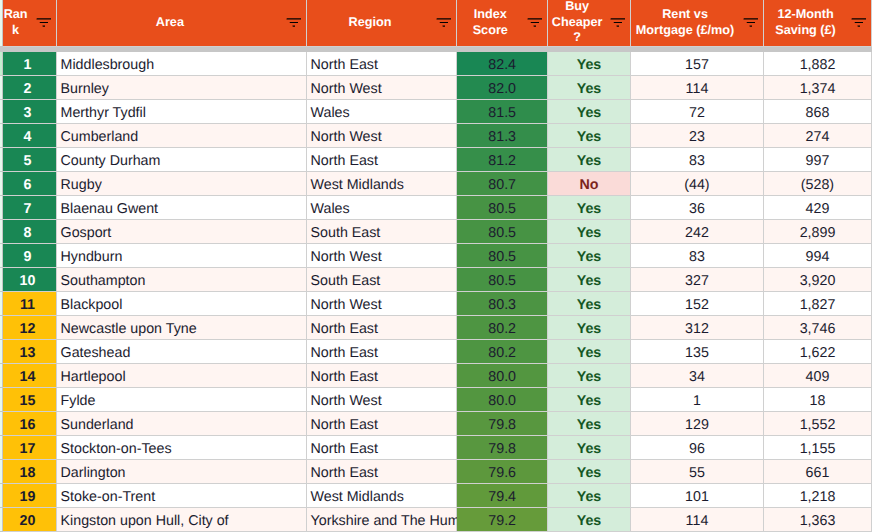
Middlesbrough topped the table, followed by Burnley and Merthyr Tydfil, reflecting comparatively low house prices and stronger affordability relative to local earnings.
Rugby was the only location in the top ten where renting remained cheaper than buying (by £44 a month), earning its place thanks to high local earnings relative to house prices.
Every North East local authority except Northumberland (ranked 73rd overall) had lower estimated monthly mortgage payments than local rents.
Although Manchester and Salford have higher average property prices than many northern locations, both ranked highly because elevated rental costs meant buyers could save more than £3,000 a year by purchasing rather than renting. Southampton offered the biggest annual saving for buyers among the index’s top ten locations, at £3,924.
The analysis also found a further 94 local authority areas where monthly ownership costs were within £100 of renting.




Comments (4)
Such comparisons would be more credible if they included the actual costs of ‘owning’ a property Vs renting one. This would include repairs & maintenance, insurance, etc… Then we would really see which costs less.
Landlords and homeowners already know the answer, while renters don’t want to know the answer.
This report measures the wrong thing.
A mortgage payment is two different things bundled together. The interest is rent, paid on however much cash you still owe. The capital element is not rent at all. It is self imposed saving, forced each month, that reduces the amount of money being rented. Every payment shrinks the balance, so the rent portion falls over time even as the total payment stays roughly flat. By month 300 the balance is zero, the rent on it is zero, and the saving has bought back the entire asset.
Ordinary renting has no such mechanism. Every pound is rent. None of it reduces anything. None of it is ever returned.
Comparing monthly mortgage payments to monthly rent, as this report does, ignores that split entirely. It treats a payment that is part rent and part forced saving as if it were the same kind of expense as a payment that is one hundred per cent rent. A renter paying £1,269 a month for twenty five years pays out well over £380,000 and owns nothing at the end of it. A buyer on a standard twenty five year mortgage has paid off the loan entirely by month 300. From that point there is no balance left to rent, so the payment stops. The renter’s payment never stops.
The report also ignores the asset itself, which will have appreciated significantly over a twenty five year term in most of these regions. That appreciation belongs entirely to the buyer, because the buyer’s capital element was steadily buying the asset back throughout.
Published by a mortgage lender, this index was always going to find that buying looks favourable. But the real case for buying was never that a mortgage payment undercuts rent by some margin in month forty seven. It is that a mortgage payment is part rent on a shrinking balance and part compulsory saving, and ordinary rent is one hundred per cent rent with no saving at all. Any report that compares the two as if they were the same kind of cost is not analysis. It is a headline dressed up as a conclusion.
You forget that rent is almost completely different to mortgage interest. Yes, you are effectively “renting” the money from the bank, rather similar to the old HP agreement on cars, and you are right that the interest should be separated from the capital repayment. But as a tenant you are not just renting a house. For starters, you are renting 100% of the value of a house, whereas most mortgages are less than 90% LTV, often below 75%. This makes a huge difference to the cost of borrowing due to the different risk level. If you properly compared renting to the cost of a 100% mortgage, the cost comparison would be very different.
Rent includes the costs of management and maintenance, risks such as non-payment and damage and consequent legal and time costs, costs of licensing, compliance and checks, possible future fines for unwitting breaches, and return on investment for the person providing the accommodation at their own personal risk instead of investing elsewhere. A homeowner takes on all of these responsibilities and costs, as far as they apply.
Costs like non-payment of rent and compliance &c don’t fall on homeowners, so for example, you can have 60 year old electrics that would never pass an EICR, whilst the landlord would have to pay thousands for a full rewire and redecoration.
So it should be astonishing and exceptional to find the cost of renting falling below the real cost of buying, given all those extra costs that the rent has to pay for. What’s most surprising is that many privately rented properties are actually rented out for less than the real cost of running them, and way below the real cost of other tenures like social housing.