

The government set a much publicised target to build 1.5 million new homes before the next election. The target was always ambitious but it is now clearly unachievable. There would be more chance of me running a 4 minute mile tomorrow!
So why are so few new homes being built and why does this matter to estate agents? Most estate agents do not earn much money directly from new home sales. However, a lot of second-hand house sales are dependent on a healthy new homes market.
For an example, an elderly couple who want to downsize need a suitable new home in order to make the sale of their existing home possible, and the sale of their existing home will probably trigger the sale of two or three other properties further down the chain.
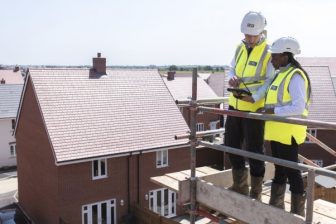
So why aren’t the developers building more new homes? In short, the answer is that it is extremely difficult for developers to make a proper profit margin at the moment. There are four important reasons for this.
Firstly, there have been price falls in many areas. Secondly, the cost of land is still very high. Thirdly, the cost of building a new home has increased enormously over the last few years. According to the Home Builders Federation it now costs £76,000 more to build a home than it did in 2020!
This figure seems scarcely believable but it is made-up of many different elements. The landfill tax has added hugely to the cost of building a new home. The cost of the community infrastructure levy has also increased. The cost of building materials has risen. The cost of labour has risen sharply due to the huge increase in the minimum wage and the imposition of a higher rate of employers National Insurance. Planning applications have become far more complex and expensive, and the cost of complying with environmental issues is very significant.
For high-rise buildings there are significant additional costs. A very big one is the cost of providing a second staircase and the cost of complying with all the additional fire regulations that were introduced after the Grenfell tragedy. A second staircase will typically mean that the finished development will have two less flats on each floor and this has a massive impact on the (Gross Development Value) of the finished development. When one considers the whole list of factors it is easy to see how the total of these additional costs reaches £76,000.
The final significant factor is the cost of providing social housing. On some developments the social housing content is 50% and this reduces the profitability of the whole development very significantly.
The country desperately needs an increased supply of new homes and the government is under huge pressure to provide them, so what can be done to achieve this? Some things will happen naturally. As the economy improves, confidence will return to the housing market and prices will begin to recover again. Market forces may also in time reduce the cost of land. However, many of the other factors could and should be influenced by government action.
For example, it would be perfectly possible for the government to reduce or abolish the landfill tax. The government could reduce the community infrastructure levy. They could also relax the regulations that require a second staircase. If the main staircase has robust fire protection, a second one should not be necessary. The government could even choose to reduce the minimum wage or reverse the disastrous increase in employers National Insurance contributions.
The final thing that the government and all the local authorities could do is to reduce the social housing percentage. If the requirement is 50% then it may not be possible for the development to be built at all. Surely it would be the better for everyone to accept 40 or 45 social housing units in a development of 100 new homes rather than to insist on 50 and end up getting none at all .
The need for more new homes is so acute, that I believe that common sense must prevail and that action will be taken to address these issues far sooner than most people expect. For everyone’s benefit let’s hope that I’m right. I wonder if Mr Burnham reads Property Industry Eye ?
Adam Walker is a business sales broker who has specialised in the property sector for over 40 years.




Comments (3)
Oooh! The presentation of your figures is somewhat frustrating!
Have house prices actually fallen? They have when compared to the cost of living, but looking at HPI we get Jan 2020 = 81.90, Jan 2021 = 87.40, Jan 2022 = 94.50, Jan 2023 = 100.00, Jan 2024 = 97.30, Jan 2025 = 100.50, Jan 2026 = 101.60. The latest data is for May where it’s 102.20.
Therefore the pound note cost of buying a home has not gone down.
However, due to the geopolitical instability of the world as a whole, market confidence is low. Housebuilders automagically pause when that happens because it makes business sense when you have shareholders to keep happy.
£76,000 more per home than in 2020. Compared to what baseline? Where? What type of home? Would the BCIS agree with the NBF???
Landfill tax – this is a good thing, otherwise, where will all the rubbish for the people go?
More CIL – ditto, otherwise where does the money to build new roads or schools come from?
Better paid workers – brilliant, because they have more money to spend on other living and buying things – which brings in tax to help pay for the NHS, schools, police, and army.
Then you say two fewer flats per floor? Including its supporting structure (i.e. side & dividing walls, etc) a wide fire escape type staircase takes up perhaps 4 metres in width and no more than 8 metres depth (3.30m floor heights with a riser height of 150mm & a going of 300mm together with landings of 1.5m). That’s a tiny 32 square metre studio flat because the typical minimum size for a flat to be mortgageable is 30 square metres. Without proper qualification many people might assume you mean two average flats, say maybe 100 square metres!!!
Social Housing does NOT lose the developers money. Typically these are built to a lower standard (and therefore cost) than the none social housing stock and then sold at a price that is only just under full market value to maintain the illusion of “affordable”. Do not think for a moment that these properties lose the developer money.
However, what the social housing does do is provide an anchor purchase for the development making it cheaper to borrow money to build it out. “Hey Mr Bank Manager, can I borrow £50million please? Look, I’ve already got a contract with a purchaser who will take 25% of the units before we’ve even broken ground! Did you know that the Government insist that I have to do it?”
The true problem is the cost of the land. And that’s definitely a sellers market. Can’t get the price I want? No worries, I’ll just hold on to it until the pips start to squeak a bit harder!
I wonder if anyone one in Government has calculated the loss to the country by not building a house? E.g loss in stamp duty, loss in taxation and Ni on employees, loss of company Corporation tax & Ni, loss in confidence due to uncertainty induced by negative house values, reduction in various values lost in property chain, reduction estate agents values, VAT and legal fee reductions…all attracting VAT etc. and so it goes on.
My guess is that they have. The problem that the UK has is that our economy is based on only two things now, the value of our properties and the service industry. We are a net importer of food and goods in all other major categories. Successive government policies since the mid 1980’s have left us in a terrible state because we’ve sold off all the silver.