 Average rents across England fell by 0.6% in April, according to the latest figures from Goodlord, adding to signs that rental market growth is continuing to slow after several years of steep increases.
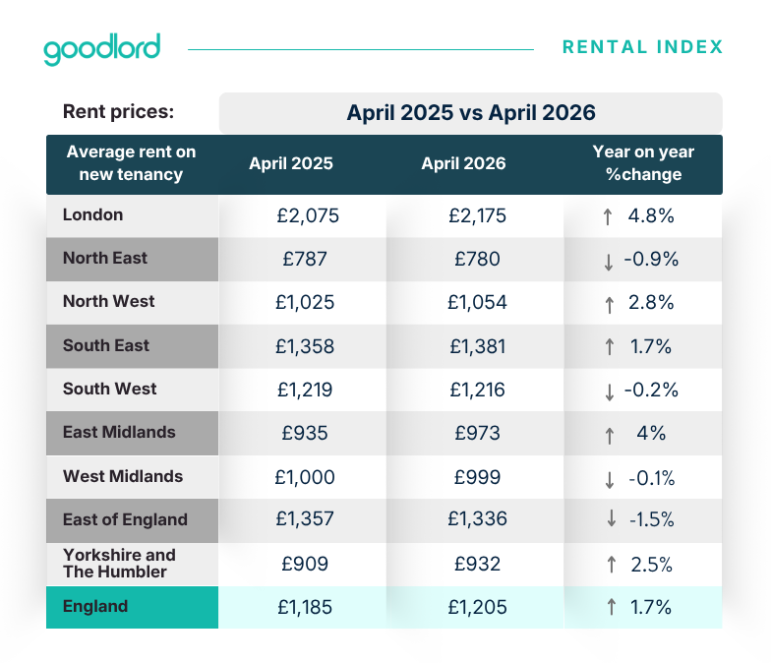
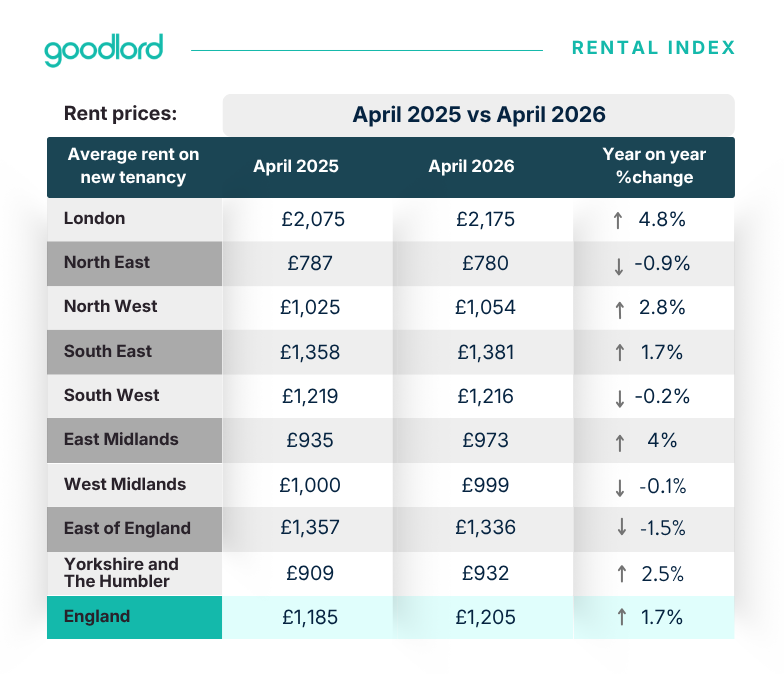
The latest Goodlord Rental Index found that average rents in April 2026 were 1.7% higher than a year earlier – the slowest annual rate of rental growth since July 2025 and less than half the 4.5% annual increase recorded in April last year.
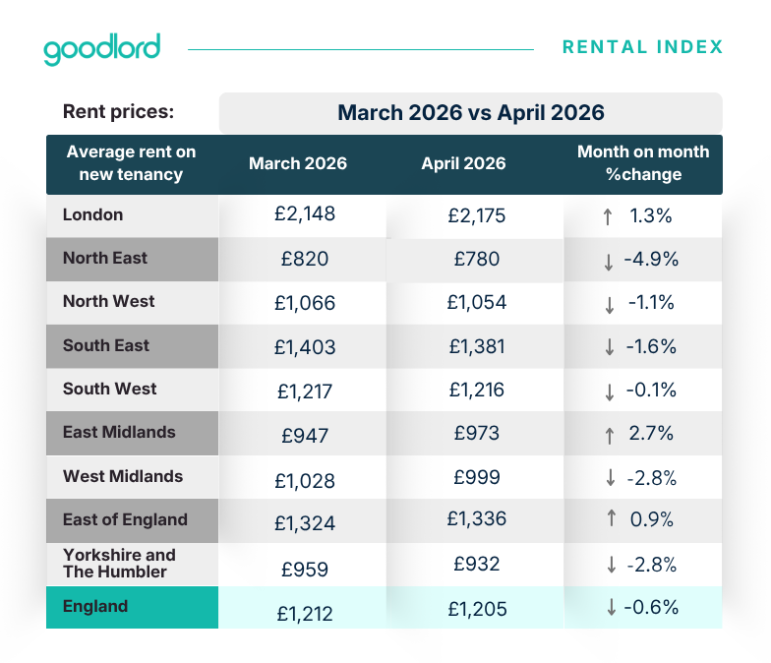
Based on verified tenancy transactions, the average monthly rent for a new tenancy in England fell from £1,212 per calendar month (pcm) in March to £1,205pcm in April.
The sharpest monthly decline was recorded in the North East, where rents fell 4.9% from £820pcm to £780pcm. Rents also dropped by 2.8% in both the West Midlands and Yorkshire and the Humber, while the South East saw average rents fall 1.6% from £1,403pcm to £1,381pcm.
Some regions continued to record growth. In London, average rents increased by 1.3% month-on-month, while the East Midlands posted the strongest rise, with rents climbing 2.7% from £947pcm to £973pcm.
The data provides one of the final snapshots of market conditions before the latest rental sector reforms came into force on 1 May under the Renters’ Rights Act.
Annual rental inflation also continued to track below wider inflation measures. Goodlord said rental growth remains lower than both Consumer Price Inflation, which stood at 3.4% in March, and wage growth, which reached 3.8% in April.
Regional trends also shifted notably during April. In March, Yorkshire and the Humber, the North West and the North East recorded the strongest annual rental growth at 6.6%, 6.3% and 5.9% respectively. By April, those figures had fallen to 2.5%, 2.8% and -0.9%.
London recorded the highest annual rental growth in April, with rents up 4.8% year-on-year, followed by the East Midlands at 4%.
Four regions – the North East, South West, West Midlands and East of England – recorded annual declines in average rents.
Meanwhile, voids increased from 22 to 24 days in April, after showing no change in the previous month.
The most dramatic lengthening in void periods was seen in the East of England (increasing from 16 to 25 days). Perhaps unsurprisingly, London saw the fastest turnaround between tenancies (17 days), as voids there were a full week shorter than the national average.
The region in which rental properties remained dormant the longest in April 2026 was Yorkshire and the Humber, where voids climbed to 29 days.
William Reeve, CEO of Goodlord, said: “We’re entering a very different rental market to the one we’ve grown used to over the past few years. Whilst we don’t typically expect to see rapid month-on-month inflation in the early part of the year, a drop in rents – coupled with a first quarter which saw very limited price increases – points to a rental market in a holding pattern.
“This is the final rental index containing figures recorded before the implementation of the Renters’ Rights Act on 1st May. What we’re seeing in April’s data is that stakeholders have been in a defensive crouch, anticipating the impact of regulatory changes. With the new legislation now in force, the big question is whether this cooler backdrop gives the sector a chance to reset on a more sustainable footing – or whether the shock of new rules jolts supply, demand and therefore prices back into a more volatile phase.”
Rental supply squeeze hits four-year high




 Average rents across England fell by 0.6% in April, according to the latest figures from Goodlord, adding to signs that rental market growth is continuing to slow after several years of steep increases.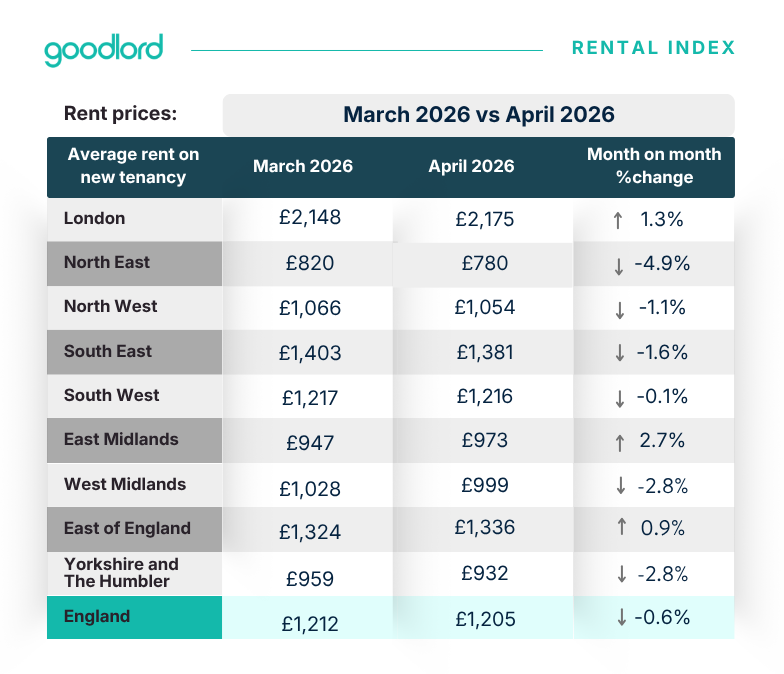

I thought there was a shortage of properties and Landlords were heading for the hills, so what’s happening to all the tenants are they doubling up or staying with mom and pop?
You must be logged in to like or dislike this comments.
Click to login
Don't have an account? Click here to register
It’s worth noting that this is just Goodlords Data and does not reflect actual facts.
You must be logged in to like or dislike this comments.
Click to login
Don't have an account? Click here to register