



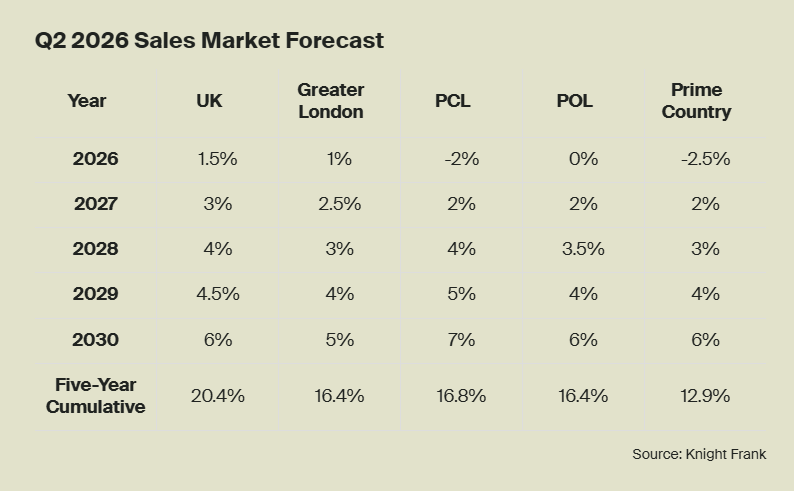
 Knight Frank has revised down its near-term UK house price forecasts, citing a weaker economic backdrop, but has become more positive about growth prospects over the longer term.
Tom Bill, head of UK residential research at Knight Frank, commented: “In short, we will only know the full impact in coming months, which depends on how long the war lasts and to what extent it escalates. If it ends relatively soon and UK labour market data stays weak, rate cuts could come back onto the agenda for the Bank of England after an inflation hump of three to six months, according to Michael Brown, an analyst at Pepperstone.
“For now, swap rates, which lenders use to price fixed-rate mortgages, have risen notably. The five-year swap rate was trading at around 4% this week compared to just under 3.5% before the war started. However, the figure has come down from 4.3% in March.”

He continued: “It is also worth noting that any effect on house prices will be mitigated by the fact more residential property is owned outright (36%) than with a mortgage (29%) in England.
“Another longer-term risk is how the government responds to the economic shock, including the prospect of tax speculation ahead of the autumn Budget. This year, there is the added uncertainty of whether Rachel Reeves and Keir Starmer will be in Downing Street after the summer.
“Making predictions at the moment comes with a particularly long list of caveats.”
Despite broad market uncertainty, Knight Frank has raised its longer-term forecasts on the assumption that a new government will take office in 2029.
Bill explained: “Given how UK politics has fragmented since the general election in July 2024, the composition and durability of any new government is uncertain. However, current polling suggests policy will be shaped by a stronger instinct for lower taxes and a tighter control over government spending.
“Such an approach has the potential to put downwards pressure on government borrowing costs and improve affordability in the housing market. Meanwhile, any wealth-related incentives would underpin demand in prime markets.
“The Conservative Party, for example, has said it will scrap stamp duty to stimulate economic growth. It would not be a straightforward process but, as we have seen in recent years, a party does not need to be in power to shift thinking on policy, especially if it resonates with the electorate. A wider question politicians will certainly need to address is whether taxing property transactions makes fiscal sense.
“While the composition of the next government is highly uncertain, we believe a change in political direction will underpin annual house price growth of more than 5% in mainstream and prime markets in 2030.”
Rental forecasts
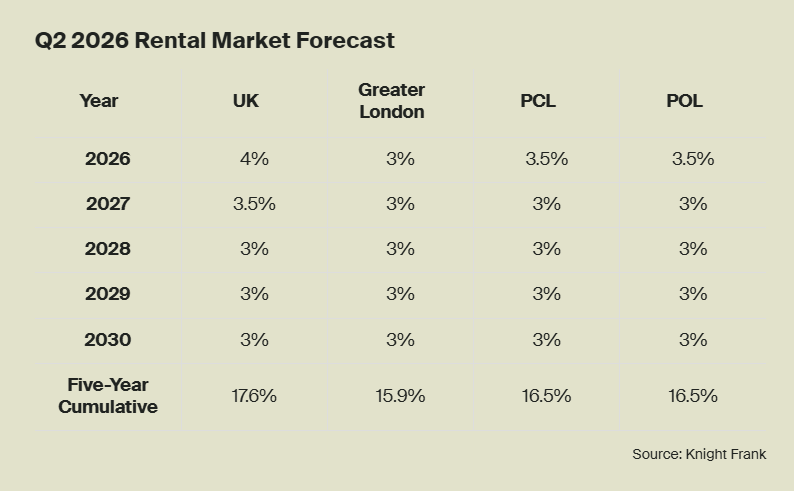
Knight Frank has lowered its rental forecasts marginally, but upwards pressure on rents will persist this year following the introduction of the Renters’ Rights Act.
Bill added: “The new rules, which come into effect on 1 May, raise the risks for landlords around repossessing or selling their property, setting rents and guaranteeing rental income. These additional risks will require extra reward and put upwards pressure on rents.
“This may be exacerbated by tighter supply as more landlords leave the sector once the new rules are in force. We expect 3.5% annual growth in prime central and outer London this year, up from the current respective rates of 1.2% and 2.8%.
“Rental activity will also benefit in the short-term as demand moves across from the sales market as higher borrowing costs curb spending power and the current geopolitical uncertainty means people keep their options open. Activity has also been supported to some extent by people looking to temporarily move back to London from the Middle East.”

What a waste of time.
You must be logged in to like or dislike this comments.
Click to login
Don't have an account? Click here to register