



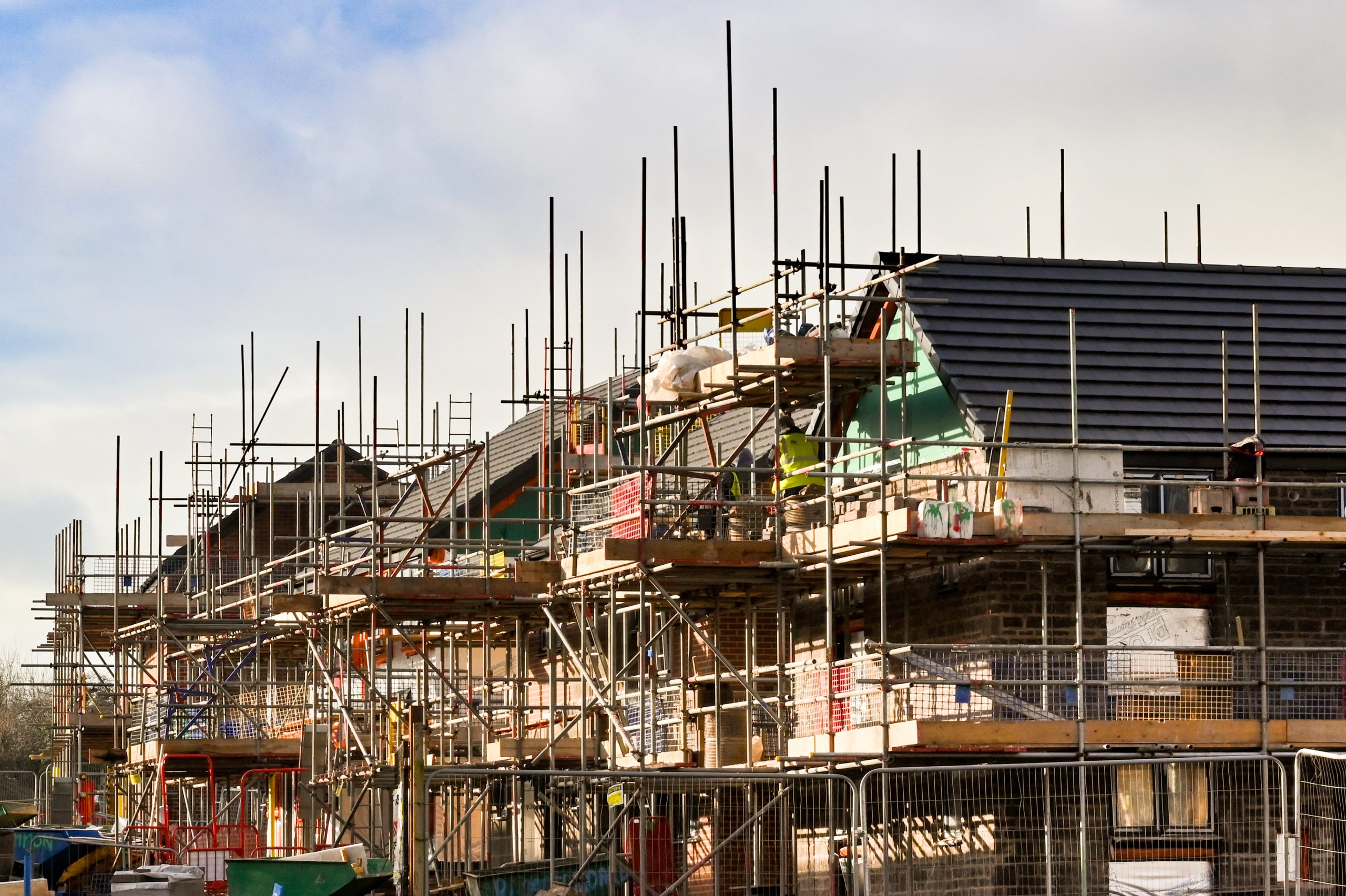
 Falling activity in private housing was the main driver of a decline in UK construction output in the three months to February 2026, according to the Office for National Statistics.
Overall output dropped by 2% compared with the previous three-month period, with new work down 3.4% and repair and maintenance flat. Within new work, private housing recorded the steepest fall, declining by 6.5%. Meanwhile, private housing repair and maintenance rose by 2%.
On a monthly basis, construction output increased by 1% in February, following an upwardly revised rise of 0.5% in January and a downwardly revised fall of 1.3% in December.
The increase was driven by gains in both new work and repair and maintenance, which rose by 1% and 0.9% respectively, with private housing new work the main contributor, growing by 4.3%.
Commenting on the figures, Neil Leitch, managing director of development finance at Hampshire Trust Bank, said: “This drop in housebuilding reflects the reality on the ground.
“Developers are still operating with very little margin for error. The challenge is not just planning delays, but planning uncertainty, with even well-prepared, policy-compliant schemes facing less predictable outcomes. That makes it harder to commit capital with confidence.”
He added: “Viability remains finely balanced. Build costs are still high, funding conditions are tighter than many expected, and land values have not always adjusted to reflect that shift.
“Margins are under pressure, reducing flexibility once schemes move into delivery and limiting how many can be taken forward with confidence.
“That is shaping behaviour across the market. Developers are becoming more selective, focusing on schemes that are deliverable in current conditions and managing how and when capital is deployed to avoid overextending in a less predictable environment.”

Comments are closed.