



 UK rents have continued to fall, while buy-to-let activity have hit record lows, new figures show.
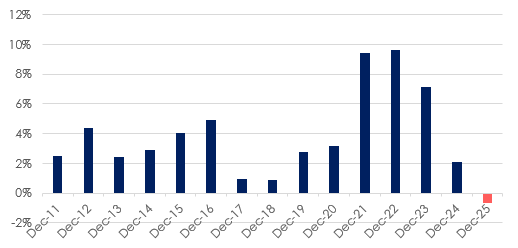
According to the Hamptons Lettings Index, 2025 marked the first full year since the index began in 2011 in which newly agreed rents fell across every month.
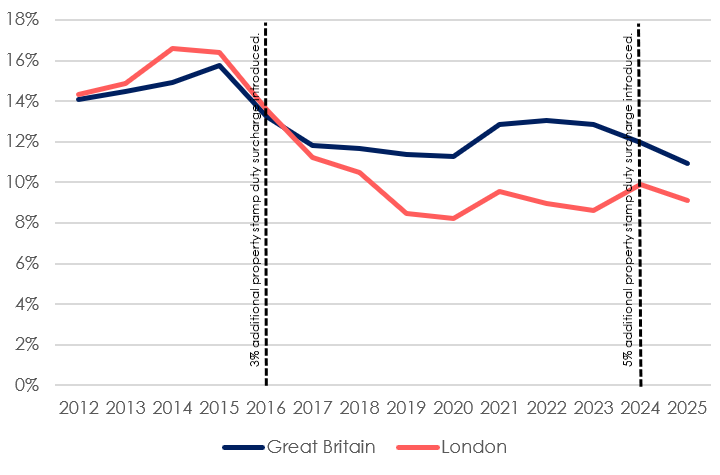
At the same time, buy-to-let investors accounted for just 10.9% of property purchases in Great Britain, down from 12.0% in 2024 and the lowest annual share since records began in 2012, as landlords faced the first full year of the 5% stamp duty surcharge.
The latest Hamptons Lettings Index, which draws on rental data from across the Connells Group, showed that newly agreed rents dipped 0.7% across Great Britain over 2025, meaning the average tenant moving into a property paid £1,371 per month, £10 a month less than last year for the same home.
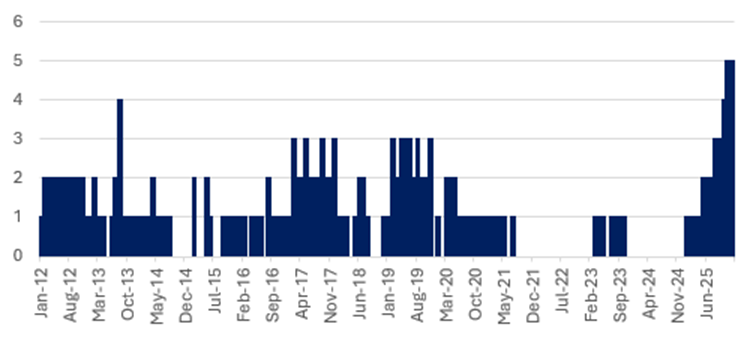
As the year progressed, more regions joined London in posting declines. Newly agreed rents first began falling in London in January 2025, but by the end of the year, five of the 11 regions in Great Britain were recording rent falls.
Chart 1 – Annual rental growth in Great Britain (new lets)
Source: Hamptons
London recorded the largest falls in newly agreed rents, down 2.7% (or £63pcm) over 2025, taking rents back to June 2023 levels. However, by December, rents were also falling in the South East (-1.0%), the East Midlands (-0.2%), Yorkshire & Humber (-1.4%) and in Wales (-0.8%).
Chart 2 – Number of regions in Great Britain recording year-on-year falls in newly agreed rents
Source: Hamptons
Three further regions – East of England (0.5%), South West (0.7%) and Scotland (0.5%) – saw growth below 1.0% in 2025. Their current trajectory suggests that these regions could tip into recording falls in early 2026.
Stock levels ended the year 6% higher than in December 2024. But perhaps more strikingly, the number of homes available to rent was only 8% below 2019 levels. During the post-Covid boom, when rents were rising by double-digits, the number of homes on the rental market fell 52% below 2019 levels. December’s increase in stock primarily reflects weaker demand from renters rather than a jump in new landlord purchases.
Landlord activity continued to slide in 2025, with just 10.9% of properties in Great Britain bought by landlords, down from 12.0% in 2024 and well below the 15.8% recorded in 2015, before the 3% stamp duty surcharge was first introduced in 2016. This marks the lowest share since our records began in 2012 and the first time it has fallen below 11.0% over a full calendar year. The decline comes during the first full year in which landlords paid the higher 5% stamp duty surcharge.
Chart 3 – Share of homes bought by a landlord in Great Britain
Source: Hamptons
Table 1 – Share of properties bought by a landlord in Great Britain
| 2015 | 2024 | 2025 | YoY | |
| London | 16.4% | 9.9% | 9.1% | -0.8% |
| South East | 15.1% | 9.1% | 11.1% | 2.0% |
| South West | 14.7% | 10.1% | 7.3% | -2.8% |
| East | 14.6% | 6.8% | 8.3% | 1.5% |
| East Midlands | 18.1% | 15.8% | 15.1% | -0.7% |
| West Midlands | 21.1% | 18.6% | 15.0% | -3.6% |
| North East | 23.3% | 26.4% | 29.0% | 2.6% |
| North West | 16.9% | 17.3% | 13.5% | -3.8% |
| Yorkshire & Humber | 15.7% | 14.6% | 14.0% | -0.6% |
| Wales | 15.7% | 8.2% | 6.7% | -1.5% |
| Scotland | 10.2% | 5.5% | 6.0% | 0.5% |
| Great Britain | 15.8% | 12.0% | 10.9% | -1.0%
|
Source: Hamptons
The North East remained the most investor-heavy region. Landlords accounted for 29% of purchases in the North East, the highest figure by a significant margin in any region of Great Britain. The East Midlands (15.1%) and West Midlands (15.0%) followed.
Northern England still leads for buy-to-let purchases, but 2025 saw a shift as falling rates boosted appetite in Southern regions. The South East, East of England and North East were the only three regions of England to record a year-on-year increase in the share of homes bought by investors.
Newly agreed rents typically set market rates in an area, with renewal rents gradually moving closer towards this level. In 2025, the average cost of a contract renewal rose 3.3% annually to £1,310pcm across Great Britain. This left a £61 gap between new lets and renewals – the smallest differential since July 2021 and down from a peak of £170 per month in October 2023.
Table 2 – Annual rental growth by region in the year to December 2025
| Region | New lets | Renewals | ||
| Average monthly rent | YoY % | Average monthly rent | YoY % | |
| Greater London | £2,294 | -2.7% | £2,268 | 0.9% |
| Inner London | £2,754 | -3.7% | £2,803 | 2.3% |
| Outer London | £1,956 | -1.6% | £1,875 | -0.5% |
| South | £1,344 | -0.2% | £1,282 | 4.3% |
| East of England | £1,255 | 0.5% | £1,248 | 4.4% |
| South East | £1,456 | -1.0% | £1,388 | 5.0% |
| South West | £1,262 | 0.7% | £1,155 | 3.1% |
| Midlands | £1,037 | 1.1% | £967 | 5.0% |
| East Midlands | £982 | -0.2% | £928 | 4.9% |
| West Midlands | £1,085 | 2.1% | £1,002 | 5.1% |
| North | £965 | 1.1% | £882 | 5.0% |
| North East | £851 | 2.0% | £767 | 3.6% |
| North West | £1,034 | 2.5% | £914 | 6.5% |
| Yorkshire & The Humber | £923 | -1.4% | £890 | 3.6% |
| Wales | £870 | -0.8% | £821 | 4.1% |
| Scotland | £1,030 | 0.5% | £897 | 5.4% |
| Great Britain | £1,371 | -0.7% | £1,310 | 3.3% |
| Great Britain (Exc London) | £1,134 | 0.4% | £1,065 | 4.6% |
Source: Hamptons
Aneisha Beveridge, head of research at Hamptons, said: “On paper, 2025 looked like a good year for tenants. Rents on new lets ended 2025 lower than they started, and tenants had more choice than before. However, falling rents were driven more by strong first-time buyer numbers and wider economic weakness than by improved tenant affordability. Fewer tenants are taking their first step into the rental market, with many staying at home longer and being reluctant to commit to the cost of renting a place of their own.
“2026 brings the implementation of the Renters’ Rights Act in May, which bans offers above the asking rent. This means that agreed rents and advertised rents may start to rise at different rates. The block on landlords accepting a price above what they asked for is likely to push up advertised rents, with more tenants making offers below the higher asking price instead. However, at least initially, it is unlikely to impact the values actually being achieved.
“But towards the back end of the year, it’s possible the implementation of the Renters’ Rights Act may start proving inflationary for agreed rents. If landlords start to find the procedural and legal machinery underpinning the new rules lacking, it is likely to slowly squeeze rental homes out of the market. From a supply perspective, the lack of appetite means the share of homes bought by investors could fall below 2025’s already low levels.”
Comments are closed.