 People buying their first home alone face almost a decade of saving to raise a deposit and cover upfront moving costs, according to new research.
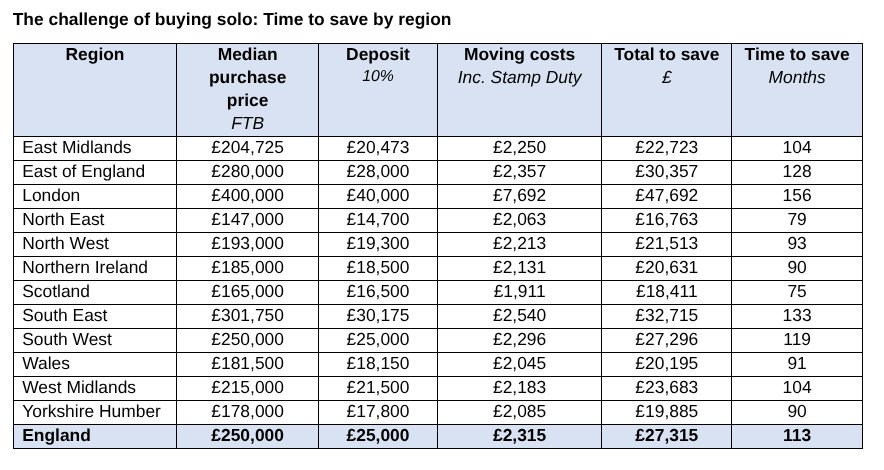
The study by home-moving comparison site Reallymoving, based on analysis of data from 40,454 conveyancing quote forms submitted by first-time buyers between June 2025 and June 2026, found that a solo first-time buyer in England would need to save for 113 months – equivalent to nine years and five months – to build up the £27,315 needed to secure a home at an average first-time buyer price of £250,000.
The calculation assumes a 10% deposit of £25,000, together with average conveyancing costs of £1,421, a survey costing £462 and removal costs of £432. These costs were based on a separate analysis of first-time buyer quotes for those services during 2025.
The savings timeline assumes the buyer can put aside 10% of their take-home pay each month, calculated using data from the ONS Annual Survey of Hours and Earnings 2025 after deducting 25% for tax, national insurance and pension contributions.
The research found that saving through a Lifetime ISA (LISA) – the tax-free savings account designed to help people buy their first home or save for retirement – would reduce the time needed to save by 23 months, to around seven and a half years.
The government recently announced plans to replace the LISA with a new First Time Buyer ISA in 2028 with no upper age limit. Until then, eligible savers aged 18 to 39 can contribute up to £4,000 a year into a LISA and receive a 25% government bonus.
Using its conveyancing quote data, Reallymoving found that the North/South divide in property prices and earnings means first-time buyers in London face the daunting task of saving for 13 years to raise the £47,692 needed to get on the housing ladder. In contrast, those in the North East need to save for approximately half the time (six years and seven months) to raise the required £16,763.
On average, buyers in the South of England need to save three years and four months longer than those in the North.
The research also found that more than half (53%) of first-time buyers purchased a three-bedroom property or larger during the past year, which Reallymoving said reflected the increasing average age of first-time buyers, now 34, and changing housing needs.
Rob Houghton, founder and chief executive of Reallymoving, said: “Raising a deposit and covering the cost of moving is still the biggest challenge facing most first-time buyers who don’t have access to financial support from parents and grandparents.
“With the cost of living and rents so high, putting money aside month after month is increasingly difficult and even first-time buyers who save consistently are looking at almost a decade of saving until they can afford to get on the housing ladder.”
Houghton said plans to introduce a new First Time Buyer ISA from 2028 were “certainly positive”, but argued the proposed £450,000 property price cap should also be reviewed to better reflect property values in London and the South East.