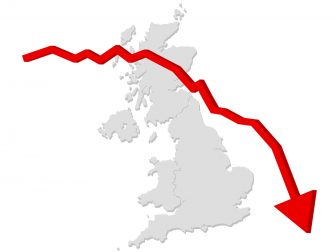
Prime property prices continued to fall in the third quarter, but the pace of decline is slowing as sellers adjust their expectations to secure deals.
New figures from Savills show prime central London values fell 1.5% between July and September, taking the annual decline to 4.8%.
Prices in the capital’s most expensive neighbourhoods now stand 27% below their 2014 peak, according to the firm’s latest prime sales index.
The downturn is also affecting markets beyond central London. Prime outer London prices fell 1.1% during the quarter and 3% over the year.
Savills said the annual decline in outer London was the steepest for more than eight years.
However, more realistic asking prices appear to be helping transactions progress.
Data from TwentyCi shows agreed sales above £1m and £2m reached 94% of their levels a year earlier during the third quarter.
Savills said activity remains concentrated among buyers with a clear need to move, rather than those making discretionary purchases.
Frances McDonald, director of research at Savills, said: “Prices in prime central London have also continued to adjust, but with concerns around the upcoming Budget far less pronounced than they were at this time last year, activity has continued at a steady pace.”
She said cash buyers and those less exposed to higher mortgage rates continued to support transactions.
£2m threshold puts further pressure on prices
The proposed High Value Council Tax Surcharge is adding to uncertainty at the upper end of the market.
Savills found that outer London houses valued at £2m or more fell 2.5% annually. Properties below £1m recorded a smaller decline of 1.3%.
A similar divide has emerged across prime regional markets.
Properties at the higher end fell 5.5% over the year, compared with a 2.9% decline for homes below £1m.
McDonald said: “The market has become increasingly sensitive to price thresholds, with £2 million now representing an important psychological as well as financial dividing line for buyers.”
She added: “A sustained return to price growth is likely to require greater certainty. Until then, the market will continue to be driven by those with a clear motivation to move.”
Regional markets feel the pressure
Prime regional property values fell 1.5% during the quarter and 4.1% annually.
The Midlands, North of England, Scotland and Wales proved more resilient, with quarterly price falls of less than 1%.
By contrast, London’s commuter belt and the wider South of England recorded declines of around 2%.
Savills attributed the sharper falls in these markets partly to fewer buyers relocating or upsizing from London.
Country house prices also remained under pressure, falling 5% over the year. However, markets including the Cotswolds and Surrey performed comparatively better.
For buyers looking to trade up, the decline in values could present opportunities.
McDonald said: “When prices soften, the gap between one property and the next often narrows, creating opportunities to secure more space or move to a preferred location for a smaller additional cost.”
Transactions taking longer
Despite signs of improving price alignment, Savills warned that country house transactions are taking longer to complete.
Buyers are scrutinising asking prices and ongoing ownership costs, particularly for properties potentially affected by the proposed council tax surcharge.
McDonald said: “Buyers are beginning to recognise the relative value available in the country house market, where price adjustments started earlier.”
She added that some locations were beginning to see a tightening supply of new properties.
However, uncertainty over taxation and borrowing costs continues to influence buyer decisions.
Savills expects the market to remain driven by motivated buyers until greater certainty returns.