




UK house price growth strengthened in March, with annual prices rising by 2.2%, up from 1% in February, according to the latest data from Nationwide.
Regionally, Northern Ireland recorded the strongest performance in the first quarter of 2026, with prices up 9.5% year-on-year.
In contrast, the Outer South East was the weakest-performing area, where prices fell by 0.7% compared with the same period last year.
| Headlines | Mar-26 | Feb-26 |
| Monthly Index* | 552.6 | 547.7 |
| Monthly Change* | 0.9% | 0.3% |
| Annual Change | 2.2% | 1.0% |
| Average Price
(not seasonally adjusted) |
£277,186 | £273,176 |
* Seasonally adjusted figure (note that monthly % changes are revised when seasonal adjustment factors are re-estimated)
Robert Gardner, Nationwide’s Chief Economist, said: “UK annual house price growth picked up to 2.2% in March, from 1.0% in February. Prices increased by 0.9% month on month, after taking account of seasonal effects.
“The pickup in house price growth suggests that the market had regained momentum after the slowdown recorded around the turn of the year. However, the sharp rise in global energy prices in response to developments in the Middle East represents a significant shock to the global economy, clouding the outlook.
“In the near term, UK economic growth is likely to be slower and inflation higher than previously expected, although ultimately the impact will depend on the duration of the shock as well as the policy response. The outlook for interest rates is particularly uncertain and dependent on whether the demand or supply side of the economy is more adversely affected.
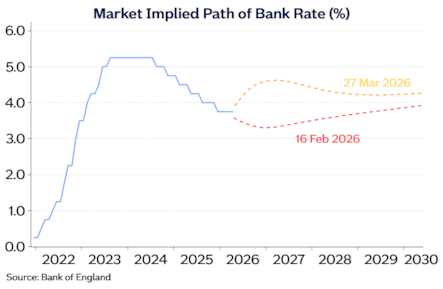
Gardner highlights that financial market expectations for the future path of Bank Rate have shifted dramatically. Towards the end of March, three interest rate increases were priced in over the next twelve months, compared to two rate cuts being anticipated before the strikes on Iran. This shift has resulted in a sharp rise in longer term interest rates (swap rates) that underpin fixed rate mortgage pricing.
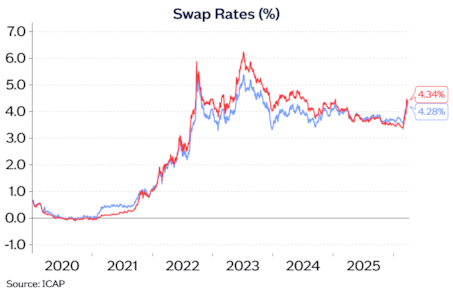
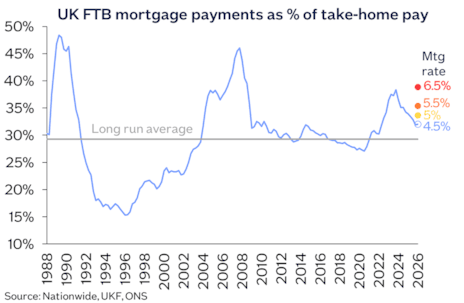
“If sustained, this could reverse some of the improvement in housing affordability that has taken place in recent years. With consumer sentiment also likely to be dented by the uncertain outlook and the prospect of rising energy costs, housing market activity is likely to soften,” he explained.
Nationwide points to the fact that the labour market has cooled markedly in recent quarters, with the unemployment rate rising towards the peak seen during the pandemic. However, this has largely been driven by people re-entering the labour force, with employment levels holding up well.
Moreover, in aggregate, household finances are solid, with household debt at its lowest level relative to income for two decades, and significant savings buffers accumulated in recent years (though these are not evenly distributed). Hopefully this will help mitigate the additional pressures, though many are still recovering from the previous cost of living crisis.
The vast majority of existing mortgage holders are protected from the immediate impact of higher interest rates, with c90% on fixed rate mortgages. Also, while swap rates have risen markedly, to date the increase is much less pronounced than that seen in the aftermath of the pandemic. Indeed, they are still at levels prevailing in late 2023 / early 2024 (as shown in the swap rate chart above).
Nationwide’s regional house price indices are produced quarterly, with data for Q1 (the three months to March) indicating that most regions saw modest annual house price growth.
Two of the 13 regions saw annual price declines – the weakest performing region was Outer South East (-0.7% year-on-year), followed by East Anglia (-0.4%). In addition, another three regions recorded annual growth of less than 1% (West Midlands, East Midlands and the South West).
At the other end of the spectrum, Northern Ireland continued to outpace the rest of the UK by a wide margin, with prices increasing by 9.5% over the year. This was more than six times faster than the 1.5% recorded in the UK as a whole (in Q1) and nearly three times higher than the 3.3% recorded in the next strongest region (North West). This strong performance mirrored that in the border regions of Ireland over the same period.
Scotland saw a pickup in annual house price growth in Q1 to 3.0%, from 1.9% in Q4 2025. This was closely followed by Wales, where prices were up 2.7% year-on-year.
England saw a further slowing in annual house price growth to 0.9%, from 1.2% in Q4. Average prices in Northern England (comprising North, North West, Yorkshire & The Humber, East Midlands and West Midlands) were up 1.5% year on year, with the North West (which includes areas such as Cheshire, Lancashire & Greater Manchester) remaining the top performing region in England – with prices up 3.3% year on year.
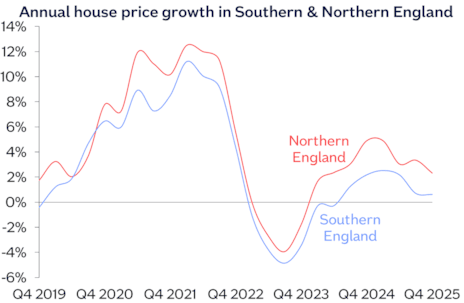
Average house price growth in Southern England (South West, Outer South East, Outer Metropolitan, London and East Anglia) remained steady at 0.6%. London was the strongest southern region, with an annual price rise of 1.7%, up from 0.7% last quarter. Meanwhile, as noted above, East Anglia and the Outer South East both saw small annual declines.
Nationwide’s most recent data by property type shows that detached properties saw the biggest percentage rise over the last 12 months, with average prices up 2.4% year on year.
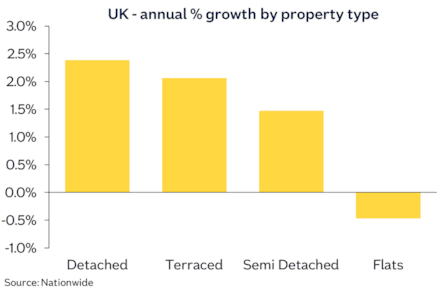
Terraced properties saw similar growth of 2.1%, with semi-detached slightly weaker at 1.5%. However, flats saw a small year-on-year decline of 0.5%.
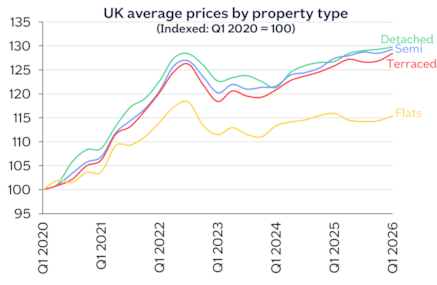
Looking over the longer term, flats have seen noticeably weaker growth than other property types. For example, since the start of 2020, the price of a typical flat has increased by 15%, half the rise in the price of detached houses, which saw a 30% rise over the same period. This is partly a reflection of regional trends where London, which has a much greater proportion of flats, has underperformed the wider UK.”
Quarterly Regional House Price Statistics – Q1 2026
These figures are for the three months to March, therefore will show a different UK average price and annual percentage change to our monthly house price statistics.
Regions over the last 12 months
| Region | Average price
(Q1 2026) |
Annual % chg this quarter | Annual % chg last quarter |
| N Ireland | £225,269 | 9.5% | 9.7% |
| North West | £229,173 | 3.3% | 3.5% |
| Scotland | £191,747 | 3.0% | 1.9% |
| Wales | £215,411 | 2.7% | 3.2% |
| North | £170,378 | 2.6% | 2.2% |
| London | £538,181 | 1.7% | 0.7% |
| Yorks & The H | £214,866 | 1.6% | 2.3% |
| Outer Met | £430,260 | 1.0% | 1.4% |
| East Midlands | £236,016 | 0.3% | 1.0% |
| South West | £305,701 | 0.1% | 0.5% |
| West Midlands | £249,722 | 0.0% | 2.3% |
| East Anglia | £273,237 | -0.4% | -0.8% |
| Outer S East | £336,036 | -0.7% | 0.1% |
| UK | £274,930 | 1.5% | 1.7% |
| UK Fact File (Q1 2026) | |
| Quarterly average UK house price | £274,930 |
| Annual percentage change | 1.5% |
| Quarterly change (seasonally adj.) | 0.7% |
| Most expensive region | London |
| Least expensive region | North |
| Strongest annual price change | N Ireland |
| Weakest annual price change | Outer S East |
Nations summary table
| Nations | Average price
(Q1 2026) |
Annual % chg this quarter | Quarterly % chg |
| N Ireland | £225,269 | 9.5% | 3.6% |
| Scotland | £191,747 | 3.0% |
1.5% |
| Wales | £215,411 | 2.7% | 0.8% |
| England | £311,601 | 0.9% | 0.7% |
Industry reaction:

Nathan Emerson, CEO of Propertymark: “An uplift in house prices will be welcomed by the market and suggests that buyer demand remains resilient despite ongoing economic headwinds. Improved sentiment, coupled with marginally better affordability conditions earlier in the year, appears to be supporting price growth.
“However, this upward movement must be viewed in context. Affordability remains stretched by historical standards, and any renewed pressure on inflation that may also affect base rate decisions could quickly temper this momentum.
“For now, it’s a positive sign that confidence is returning, but sustained growth will depend on stability in borrowing costs and a consistent flow of motivated buyers entering the market.”
Amy Reynolds, head of sales at Antony Roberts: “The property market continues to demonstrate resilience despite a backdrop of global uncertainty.
“The Middle East conflict has contributed to increased caution across financial markets. Mortgage rates have already edged upwards in response, and this is naturally becoming a talking point among applicants.
“We are seeing a slight softening in viewing numbers as some buyers pause to assess the situation; however, the underlying market remains robust. Serious buyers are still very much active, with second viewings continuing and sales being agreed at levels typical for this time of year. While there is greater awareness of cost, for the right property, committed buyers are continuing to move forward with confidence.”
Mark Harris, chief executive of mortgage broker SPF Private Clients: “Mortgage rates continue to rise as lenders deal with volatile funding costs and demand from borrowers for the most competitively-priced deals.
“We have seen a significant increase in enquiries from those due to take out a mortgage in the coming months, with many wisely securing a rate now for peace of mind in case they rise further.
“With the Bank of England voting to keep rates at 3.75 per cent this month, a further hold next month rather than a knee-jerk reaction to raise rates would help steady the ship until we have a clearer idea of how long the war might last.”

Tom Bill, head of UK residential research at Knight Frank: “The impact from the Middle East conflict on the housing market is still in the post. The fact mortgage offers last for six months means the effect of higher borrowing costs will filter into the market this spring and summer, putting downwards pressure on prices and transaction volumes.
“The longer-term impact hinges on the intensity and length of the conflict. That said, one mitigating factor is the amount of equity in the system and the fact more homes are now owned outright than with a mortgage.”
Alice Haine, personal finance Analyst at Bestinvest by Evelyn Partners:
“UK house price growth accelerated in March, rising by 2.2% on the year, up from 1.0% in February, as the housing market showed signs of renewed momentum despite the outbreak of fresh conflict in the Middle East. Monthly house price growth also strengthened to 0.9% from 0.3% the previous month – a marked turnaround from the sluggish end to 2025 when concerns around potential property taxation in the Autumn Budget briefly stalled activity in the final quarter.
“The growth seen in March could, however, prove to be the calm before the storm, if borrowing costs continue to climb in response to the latest geopolitical shock. Escalating tensions in the Middle East have upended inflation and interest rate expectations, something that could dampen demand if buyers find it harder to secure the mortgages they need.
“Stock levels have increased since the start of the year, and mortgage approvals rose by almost 4% in February, but last month’s activity will have been driven by buyers who began the purchase process before the conflict unfolded. At that stage, affordability was improving, helped by easing inflation, softer mortgage rates and expectations that the Bank of England would deliver its seventh interest rate cut since August 2024 imminently.
“The outlook has shifted dramatically since then. Instead of cutting rates, the BoE held the headline rate at 3.75% and struck a notably hawkish tone as it moved to contain inflationary pressures. As the nation braces for rapidly rising prices once again – driven by a sharp surge in global energy costs in recent weeks – the property market could be impacted if more buyers struggle to secure the level of borrowing they need or decide to ‘wait and see’ how conditions evolve.
“The Bank of England is now in ‘wait and see’ mode, with the most likely outcome being rates on hold for the rest of the year rather than the cuts expected before the conflict broke out. Rates remaining elevated for longer will be particularly disappointing for the 1.8 million mortgage holders with fixed-rate deals expiring this year*. Many will be rolling off ultra-low-rate, five-year fixes into a far higher interest rate environment. These borrowers were already preparing to refinance at rates above their current deals but now face the prospect of an even steeper jump, which will place additional strain on disposable incomes.
“Those refinancing shorter-term deals will also be feeling uneasy. Falling mortgage rates had been improving affordability in recent months, while a more flexible lending landscape, and broader product choice was helping first-home purchasers to get on the ladder. Now average two-and five-year fixed rates are rising once again, reflecting movements in the swap markets, and product choice is narrowing as lenders pull deals amid rapidly shifting interest rate expectations.
“With so much uncertainty, house price growth could come under pressure over the longer term if borrowing costs continue to climb and more households delay moving. While committed movers may still push ahead, sellers may need to price realistically to secure a sale as buyers face the dual challenge of higher borrowing costs and reduced purchasing power.
“Anyone remortgaging or securing their first home loan would be wise to seek guidance from an independent broker who can scour the whole market for the best deal and help existing borrowers avoid costly standard variable rates. Once a product is secured, it is crucial to stay in close contact with your broker, particularly if conditions improve, as they can often switch you to a better rate right up until two weeks before the term begins.”

Jason Tebb, president of OnTheMarket: “This data shows just how much market activity and sentiment continued to pick up at the start of this year, with buyers and sellers proceeding with their moves with more clarity and confidence.
“While interest rate rises, rather than previously-expected reductions, seem increasingly likely depending on inflationary pressures, six interest rate cuts in the past 20 months have greatly assisted affordability and put borrowers in a stronger position.
“Those who have already delayed the decision to move for various reasons are actively engaged in the market and are pressing on despite the Middle East conflict, with our own property sentiment index showing that buyers and sellers are adopting a more pragmatic outlook rather than a loss of confidence.”
Karen Noye, mortgage expert at Quilter: “Nationwide’s latest house price index reveals modest movement in March, with house prices rising by 0.9% over the month and 2.2% annually, bringing the average UK house price to £277,186.
“Today’s figures capture the early stages of the repricing that has taken place in mortgage markets since the start of the Iranian conflict. While some resilience in house prices appears to have remained for now, momentum will likely soften in the months ahead as higher mortgage rates and increased economic uncertainty weigh on buyer confidence.
“Expectations of easing borrowing costs and gradually improving affordability had been supporting activity at the start of the year, but any real progress has been rapidly undone in the last month. Since the start of the conflict, mortgage rates have risen sharply and lenders have been withdrawing products or repricing fixed rate deals at short notice. For prospective home buyers and movers, this has meant a rapid deterioration in affordability.
“First-time buyers are likely to feel this most acutely, given their sensitivity to changes in rates and stress testing, but it also risks dampening activity further up the chain as existing homeowners delay moving plans in the face of higher borrowing costs. The full effect of higher borrowing costs, weaker confidence and tighter household budgets will take time to feed through, but we can expect the housing market to be stuck in a holding pattern unless anything changes soon.
“For those with mortgages due to renew later this year, it is vital to act early. Securing a new deal as soon as possible can provide certainty at a time when rates are moving quickly, and borrowers are usually able to amend or switch to a cheaper option if pricing improves before their existing deal ends.”

Jeremy Leaf, north London estate agent: “Although always a very useful snapshot of house prices from the UK’s largest building society, the data here mostly covers the period before Middle East hostilities emerged.

Comments are closed.