



 House price growth remained steady in February, with annual growth unchanged at 1.0%.
Prices rose by 0.3% month on month, while continued improvements in affordability helped support first-time buyer activity during 2025.
| Headlines | Feb-26 | Jan-26 |
|---|---|---|
| Monthly Index* | 547.0 | 545.4 |
| Monthly Change* | 0.3% | 0.3% |
| Annual Change | 1.0% | 1.0% |
| Average Price
(not seasonally adjusted) |
£273,176 | £270,873 |
* Seasonally adjusted figure (note that monthly % changes are revised when seasonal adjustment factors are re-estimated)
Robert Gardner, Nationwide’s chief economist, said: “This [latest property price data] reinforces the view of a modest recovery after a dip at the end of 2025, most likely reflecting uncertainty around potential property tax changes ahead of the Budget. Nevertheless, the number of mortgages approved for house purchase remain close to the levels prevailing before the pandemic.
“Looking across 2025 as whole, total housing market transactions were 10% higher than in 2024. As we explored in our Housing Affordability Report, improved affordability and an easing in credit availability has helped to support first-time buyer activity, with mortgage completions up 18% year on year.
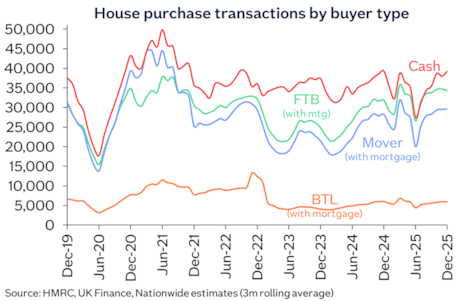
Home mover transactions involving a mortgage have also recovered over the past year, with activity up 15% year on year.
Gardner continued: “There has also been a gradual increase in the number of buy-to-let purchases involving a mortgage, although activity remains quite subdued compared to historic levels, reflecting the continued headwinds impacting this part of the market. For example, the higher interest rate environment tends to exert more of a drag on landlord demand (rather than owner occupier), while changes to the regulatory environment have also impacted landlord sentiment.
Cash transactions last year were at a similar level to 2024. In recent years, there had been something of a decline in the share of cash purchases, which accounted for 35% of transactions in 2025, down from a peak of 42% in 2023.
“Housing market activity is likely to recover in the coming quarters, especially if the improving affordability trend seen last year is maintained as expected,” Garber added.
Industry reaction:
“Activity is picking up as committed buyers re-enter the market. There is clear pent-up demand from those who paused decisions last year, and many are now keen to move before conditions shift again. As a result, agreed sales are increasing and well-priced properties are attracting competition.”
Nathan Emerson, CEO of Propertymark: “Today’s figures from Nationwide show continued upward movement in house prices, reflecting resilient demand in many parts of the UK despite ongoing affordability constraints.
“While rising prices may signal confidence in the market, they also reinforce the need for policies that support supply and improve access for first-time buyers. Without increasing the number of homes available, sustained price growth risks further stretching affordability.
“Propertymark member agents continue to report that well-priced homes are attracting strong interest. However, a stable and balanced market, rather than rapid price inflation, is key to long-term sustainability and consumer confidence.”
Iain McKenzie, CEO of The Guild of Property Professionals: “February’s Nationwide House Price Index paints a picture of a market finding its footing after the dip at the end of last year. With prices holding steady and annual growth unchanged at 1%, alongside a modest 0.3% monthly uplift, we’re seeing clear signs of a measured recovery rather than a rapid rebound.
“One factor keeping price growth in check is the elevated level of supply, giving buyers both great choice and negotiating power. This is helping to stabilise values even as demand begins to improve. This balance is healthy for the market and supports sustainable growth rather than short-term spikes.
“Transaction data from HM Revenue & Customs reinforces the picture of a market in transition. January’s seasonally adjusted total of 94,680 residential transactions was marginally lower year-on-year and 5% down on December, marking the first notable dip after several months of stability. While this slowdown reflects seasonal and affordability pressures, it also suggests pent-up demand that could be released as conditions improve.
“Encouragingly, the direction of travel for borrowing costs is positive. Falling inflation, now at 3%, its lowest level since March 2025, combined with expectations of base rate cuts from the Bank of England, is feeding through to more competitive mortgage pricing. Lenders are actively vying for business, and improved affordability, particularly for buyers with larger deposits, should help unlock activity as the year progresses.
“Looking ahead, we expect momentum to build gradually through 2026. While geopolitical uncertainties could influence inflation, the broader trajectory points towards easing monetary policy and improving buyer confidence. In this environment, sales volumes are likely to strengthen, and the market should continue its steady, sustainable recovery.”
Jeremy Leaf, north London estate agent: “Demand has picked up over the last month or so with buyers breathing a collective sigh of relief that Budget measures weren’t as potentially damaging as rumours would have us believe. There is added confidence that the spring statement this week will prove even more of a non-event in terms of its influence over decision-making.
“We are finding worries about employment and the economy generally are of more concern now as well as over-supply, particularly of flats. Improving affordability and lending criteria means we are also seeing more first-time buyers. Stock levels have been reinforced by landlords ready to sell than renew existing tenancies in view of new tax and regulatory measures.”
Tom Bill, head of UK residential research at Knight Frank: “House price growth was flat in February as the post-Budget bounce tailed off. Activity levels have been solid but unspectacular in recent weeks but demand will strengthen if mortgage rates continue to head lower. However, a period of domestic political uncertainty caused by a Labour leadership challenge could take the edge of any recovery. A protracted conflict in the Middle East could also dampen sentiment or have an inflationary impact but it’s too early to assess the likelihood of either.”
Tomer Aboody, director of MT Finance: “A period of lower mortgage rates, combined with a lack of patience and eagerness to get deals done after inertia in the run-up to the Budget, should see transaction levels edge higher in coming months.
“The housing market is vital to the UK economy, and even through tough times buyers and sellers have maintained activity, albeit at a lower intensity.
“With the spring forecast imminent, the government must examine current market realities for first-time buyers in particular and work alongside specialist providers to expand access and boost transactions, rather than relying solely on high-street lenders to deliver for all.”
Mark Harris, chief executive of mortgage broker SPF Private Clients: “Lower mortgage rates continue to support housing market activity. Enquiry levels are strong as buyers who put decisions on hold last year now feel ready to proceed, particularly as improved affordability is making them feel more confident about committing to a property purchase.
“Signs of a pick-up in buy-to-let mortgage lending are also welcome, as private landlords are essential to the smooth functioning of the private rented sector.
’The chances of another interest rate cut this month have improved as unemployment rises, inflation falls and economic growth is lacklustre. This will provide a welcome boost as the weather continues to improve and we move into the traditionally busier spring market.”
Ian Futcher, financial planner at Quilter: “House prices appear to be off to a steadier start in 2026 according to Nationwide’s latest house price index, rising by 0.3% in February which matches the 0.3% uptick seen in January. Annual house price growth was also unchanged, rising by 1%, which brought the average house price to £273,176.
“While this suggests a gradual recovery compared to the dip seen towards the end of last year, we are unlikely to see a marked uplift in house prices for a while yet. Residential property transactions data out last week show that despite the slight easing of mortgage rates and more competitive offerings being brought to the market by lenders, the market remains very much subdued. On a seasonally adjusted basis, residential transactions were down 5% compared to December 2025, and were marginally lower than January 2025. On a non-seasonally adjusted basis, these figures jump to a 24% drop and a 3% fall respectively.
“While lenders are vying for business and bringing cheaper products to the table, as well as higher loan to income and loan to value offerings, affordability is still stretched. With the prospect of further rate cuts throughout 2026, many will be holding out in hopes of securing a cheaper deal later down the line. Until rate cuts are more clearly evidenced and there is significant downward pressure on mortgage rates, prompting more people to put moving plans back in motion, we can expect house prices to remain relatively stagnant.
“Mortgage rates are typically set well in advance of any Bank of England interest rate changes, so if we see them ease further in the coming months as cuts are anticipated, affordability pressures will lessen. Buyer confidence has been low in recent years, but an improving rate outlook could see demand, and subsequently house prices, pick back up.”

Comments are closed.