




Rental demand has fallen sharply this year as the gap between supply and demand in the private rented sector continues to narrow, according to Zoopla’s latest Rental Market Report.
Annual rental growth slowed to 2.2% at the end of October 2025, down from 3.3% a year earlier, marking the weakest pace of increase in several years. Average UK rents now stand at £1,320 per month, £30 higher than last year.
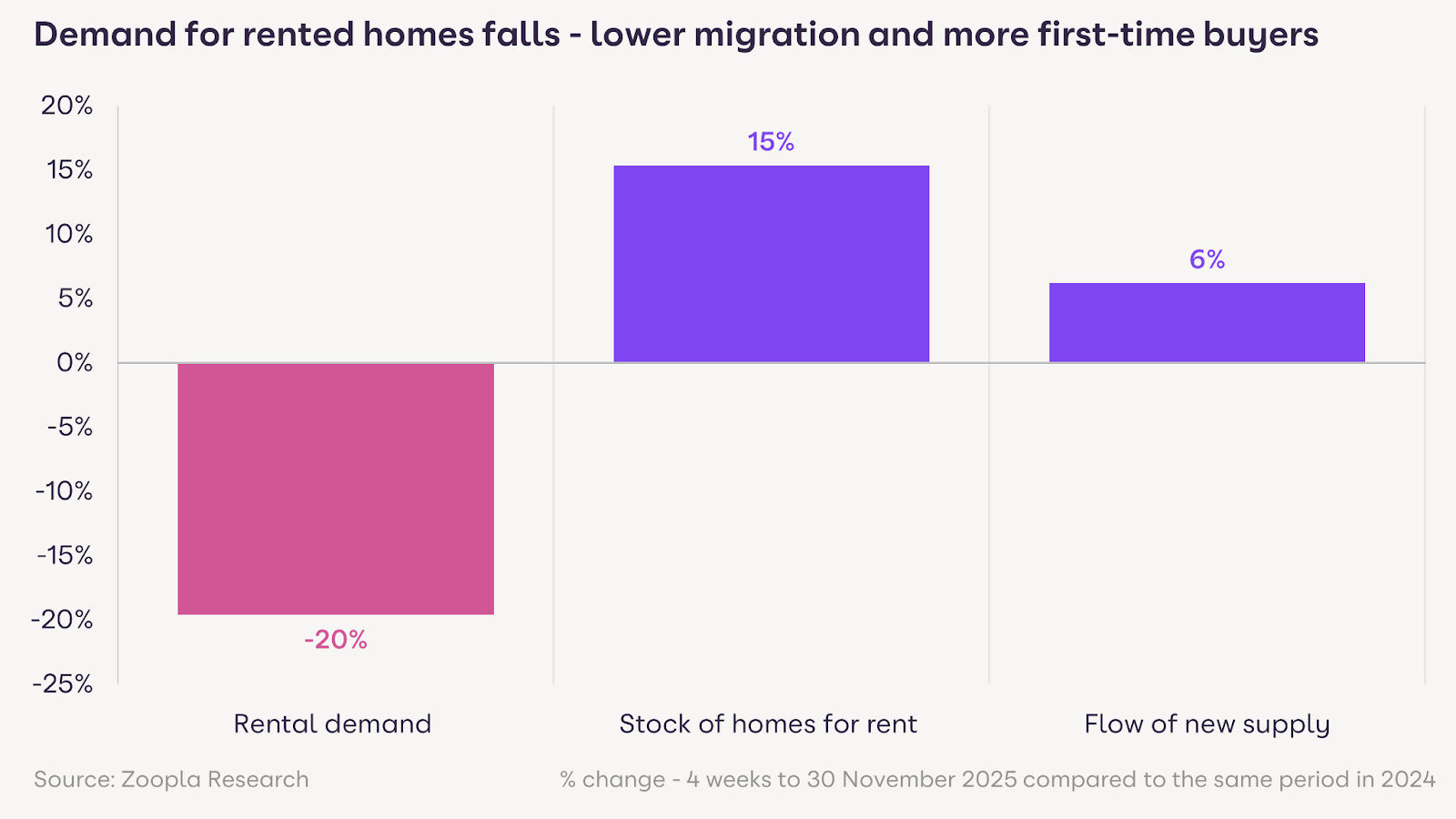
Demand for rented homes has dropped by 20% over the past 12 months. Zoopla attributes the decline to two key factors: a steep reduction in net migration and improved mortgage affordability for first-time buyers.
Provisional ONS figures indicate that net migration fell by 78% between June 2023 and June 2025, significantly reducing pressure on the rental market. At the same time, lower mortgage rates and easing lending conditions have encouraged more first-time buyers to enter the market.
The number of first-time buyers purchasing homes is on course to be 20% higher in 2025, with many moving out of the rental sector and freeing up stock. As a result, the supply of rental properties has improved, with 15% more homes available to let than a year ago.
Letting agents now have an average of 14 homes for rent per branch, up from a low of eight in 2022, though still below the pre-pandemic average of 17.
Demand for rented homes falls
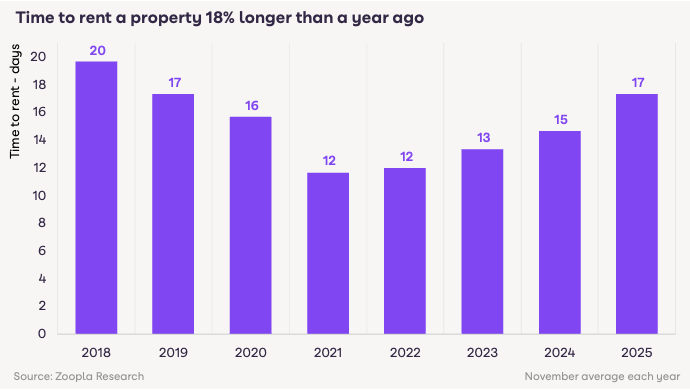
The time it takes for a property to rent is a key barometer of rental market health and indicates how supply and demand are shifting in real time. The time to rent has been increasing, with the average home staying on the market for 17 days before being rented. This is almost a fifth higher (18%) than a year ago and 42% longer than during the demand boom for rented homes during the pandemic.
The time to rent has increased across all regions and countries of the UK as the pressure on the rental market has cooled, with the average ranging from 14 days in Scotland to 19 in the West Midlands. Longer times to let will limit how much rents can be increased, which means lower levels of rental growth over 2026.
Time to rent (days), UK – November average each year
Rental inflation across the regions and countries of Great Britain has slowed over the last year. Overall, rental growth is strongest in lower-value markets where affordability provides more headroom for rental increases, while higher-value areas are seeing slower growth as stretched affordability limits further rent rises.
At a country and region level, rents are rising fastest in the North East (4.5%) and North West (3.2%), while growth is weakest in London (1.6%) and in the West Midlands and Scotland (both 1.7%).
The changes in supply and demand do not play out equally across the country. Some local markets are registering a decline in rents for new lets, with rents lower than a year ago in the Birmingham (-1.5%) and Dundee (-1%) postal areas. In contrast, rents are rising fastest in Carlisle (8.1%), Chester (7.4%) and Motherwell (7%). These differences reflect the affordability of rents relative to local incomes, as well as demand and supply.
Richard Donnell, executive director at Zoopla said: “The rental market has made a big stride back towards normality over 2025 after a prolonged period of sky-high demand and a lack of homes for rent. This is welcome relief for renters who can expect to see a greater choice of homes, slower rent increases and a less competitive market.
“However, the high costs of buying a home remain a barrier to many renters, which will support demand for renting over 2026. While there are signs that landlords are buying homes again, we do not expect a big increase in supply, meaning rents are set to increase by 2.5% over 2026.”
Rents and rental inflation – regions and countries
|
Country/region |
Average rent October 2025 |
Rental inflation %yoy Oct-25 |
Rental inflation %yoy Oct-24 |
|
London |
£2,224 |
1.6% |
1.0% |
|
Scotland |
£882 |
1.7% |
4.8% |
|
West Midlands |
£986 |
1.7% |
4.5% |
|
Yorkshire and the Humber |
£869 |
1.8% |
4.1% |
|
East Midlands |
£923 |
1.9% |
3.0% |
|
South East |
£1,397 |
2.1% |
4.0% |
|
Wales |
£945 |
2.4% |
4.3% |
|
Eastern |
£1,263 |
2.5% |
4.7% |
|
South West |
£1,149 |
3.0% |
3.8% |
|
North West |
£955 |
3.2% |
5.2% |
|
North East |
£760 |
4.5% |
7.4% |
|
Northern Ireland |
£854 |
11.0% |
7.4% |
|
United Kingdom |
£1,318 |
2.2% |
3.3% |
Source: Zoopla Rental Index, October 2025

Maybe rents have just peaked and landlords are worried can their tenants afford another rent increase? Also tenants are staying put. Landlords are waiting for this Government to go in the hope that maybe CGT will reduce when a new Gov. comes in. Even with the 2% tax increase for landlords I don’t think landlords will rush into rent increases or to just sell up. Not in the present economy.
You must be logged in to like or dislike this comments.
Click to login
Don't have an account? Click here to register
Percentages mean NOTHING without statement of underlying figures.
NET migration is down. But the important word is NET. The net migration in 2025 is 204,000 people coming into the country. That NET number also takes account of the number of people who left the country. I can’t imagine that every single one of these people immediately moved in with friends or family… However, given the disastrous effect that the reduction in immigration has had on our universities, it is possible that a huge percentage of these are still students, but far fewer than before…
The increase in first time buyers is expected to be 20% higher in 2025 than in 2024. The maths says that’s roughly 58,300. However, my guess is that a significant percentage of these will actually be moving out of their parents’ houses rather than from a rented property.
I suspect that the real picture is waaaay more complicated than is being presented in this article or the original information provided by Zoopla. But, of course, somebody needed to publish something, even if the analysis and conclusions were garbage!
You must be logged in to like or dislike this comments.
Click to login
Don't have an account? Click here to register